
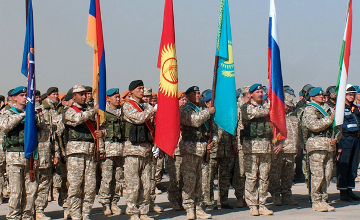
DUSHANBE, May 19, 2015, Asia-Plus – A snap inspection of combat readiness of the Collective Security Treaty Organization (CSTO) Collective Operational Reaction Force (CORF) has entered its final phase.
Faridoun Mahmadaliyev, a spokesman for the Ministry of Defense of Tajikistan (MoD), says SCTO Secretary General Nikolai Bordyuzha, Tajik Defense Minister Sherali Mirzo, Tajik President’s Adviser on National Security Sherali Khairulloyev and commanders of contingents from Armenia, Belarus, Kazakhstan, Kyrgyzstan and Russia are observing the final stage.
“On May 20, the snap inspection staff will discuss the training results and the contingents of Armenia, Belarus, Kazakhstan, Kyrgyzstan and Russia will leave Tajikistan on May 21,” Mahmadaliyev said.
This exercise that began the afternoon of May 12 and involves more than 2,500 servicemen, about 200 military hardware, 20 combat jets and helicopters as well as 30 military transport planes is being conducted at the Harbmaydon training ground in the Tajik southern province of Khatlon.
The CORF contingents are practicing quickly deploying to the border of Tajikistan. The Armenian, Belarusian, Kazakh and Russian forces arrived by air while the Tajik and Kyrgyz units reportedly marched hundreds of kilometers through mountainous terrain to get to the site.
We will recall that speaking at a press conference in Dushanbe, CSTO Secretary-General Nikolai Bordyuzha said on March 13 that the CSTO military forces could be at the Tajik-Afghan border within three days if a conflict broke out there.
The CORF is a Russian initiative intended to transform and expand by three to four times the CSTO rapid reaction dimension into a permanently ready, combat-capable force designed for intervention in crisis situations on the territory of CSTO member stat
On February 4, 2009, an agreement to create the Collective Operational Reaction Force (CORF) was reached was by five (Armenia, Kazakhstan, Kyrgyzstan, Russia and Tajikistan) of the seven CSTO members. The force is intended to be used to repulse military aggression, conduct anti-terrorist operations, fight transnational crime and drug trafficking, and neutralize the effects of natural disasters. Belarus and Uzbekistan initially refrained from signing on to the agreement; Belarus because of a trade dispute with Russia, and Uzbekistan due to general concerns. Belarus signed the agreement in October 2009.
The CSTO now groups Armenia, Belarus, Kazakhstan, Kyrgyzstan, Russia, and Tajikistan.