
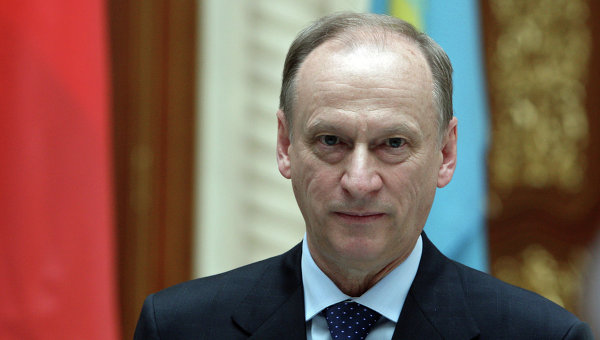
DUSHANBE, May 20, 2015, Asia-Plus — The intensification of the United States and NATO offensive potential near the Russian border creates threats not only to Russia, but also to its allies, Russian Security Council Secretary Nikolai Patrushev was quoted as saying by Russian media outlets on May 20.
“Indirect actions have become typical in the fight of governments for their interests: the use of protest potential of the population, radical and extremist organizations, and private military campaigns. US and NATO aggressiveness toward Russia is growing, and their offensive potential right on the Russian border is growing, which is creating threats not only to us, but to our allies,” Patrushev was quoted as saying by the Russian Security Council’s press center after a meeting of the Committee of Security Council Secretaries from the Collective Security Treaty Organization (CSTO) member nations that took place in the Tajik northern city of Khujand on May 20.
Russian media outlets report relations between NATO and Moscow deteriorated following Crimea”s reunification with Russia and the escalation of the Ukrainian crisis in 2014. In April 2014, the alliance suspended all practical cooperation with Russia, accusing Moscow of fueling the conflict in Ukraine.
Russia has repeatedly denied these accusations and voiced concern over NATO”s increased military presence close to its western borders.
On May 14, during a NATO foreign minister session in Antalya, Turkey, NATO Secretary-General Jens Stoltenberg said that the alliance had no plans to resume cooperation with Russia, regardless of global threats such as the advance of the Islamic State terrorist group. Instead, he stated that NATO would boost its reinforcements in Eastern Europe, according to RIA Novosti.
Meanwhile, the latest developments in Afghanistan and their influence on the situation in the CSTO area of responsibility (AoR) were also among major topics of the meeting in Khujand.
The meeting participants also discussed the results of the snap inspection of combat readiness of the CSTO Collective Operational Reaction Force (CORF) that took place on May 12-19.
Besides, the Security Council Secretaries from the CSTO member nations discussed functioning of the system of collective response to emergency situations and training of personnel for armed forces and law enforcement agencies of the CSTO member nations.
Security Council Secretaries from Armenia, Kazakhstan, Kyrgyzstan, Russian and Tajikistan as well as the CSTO Secretary General Nikolai Bordyuzha participated in the meeting that was presided over by the Tajik Security Council Secretary, Abdurahim Qahhorov.
The regional security organization was initially set up in 1992 in a meeting in Tashkent and Uzbekistan once already suspended its membership in 1999. However, Tashkent returned to the CSTO again in 2006 The regional security organization was initially formed in 1992 for a five-year period by the members of the CIS Collective Security Treaty (CST) — Armenia, Kazakhstan, Kyrgyzstan, Russia, Tajikistan, and Uzbekistan, which were joined by Azerbaijan, Georgia, and Belarus the following year. A 1994 treaty reaffirmed the desire of all participating states to abstain from the use or threat of force, and prevented signatories from joining any “other military alliances or other groups of states” directed against members states. The CST was then extended for another five-year term in April 1999, and was signed by the presidents of Armenia, Belarus, Kazakhstan, Kyrgyzstan, Russia, and Tajikistan. In October 2002, the group was renamed as the CSTO. Uzbekistan that suspended its membership in 1999 returned to the CSTO again in 2006 after it came under international criticism for its brutal crackdown of antigovernment demonstrations in the eastern city of Andijon in May 2005. On June 28, 2012, Uzbekistan announced that it has suspended its membership of the CSTO, saying the organization ignores Uzbekistan and does not consider its views. The CSTO is currently an observer organization at the United Nations General Assembly.