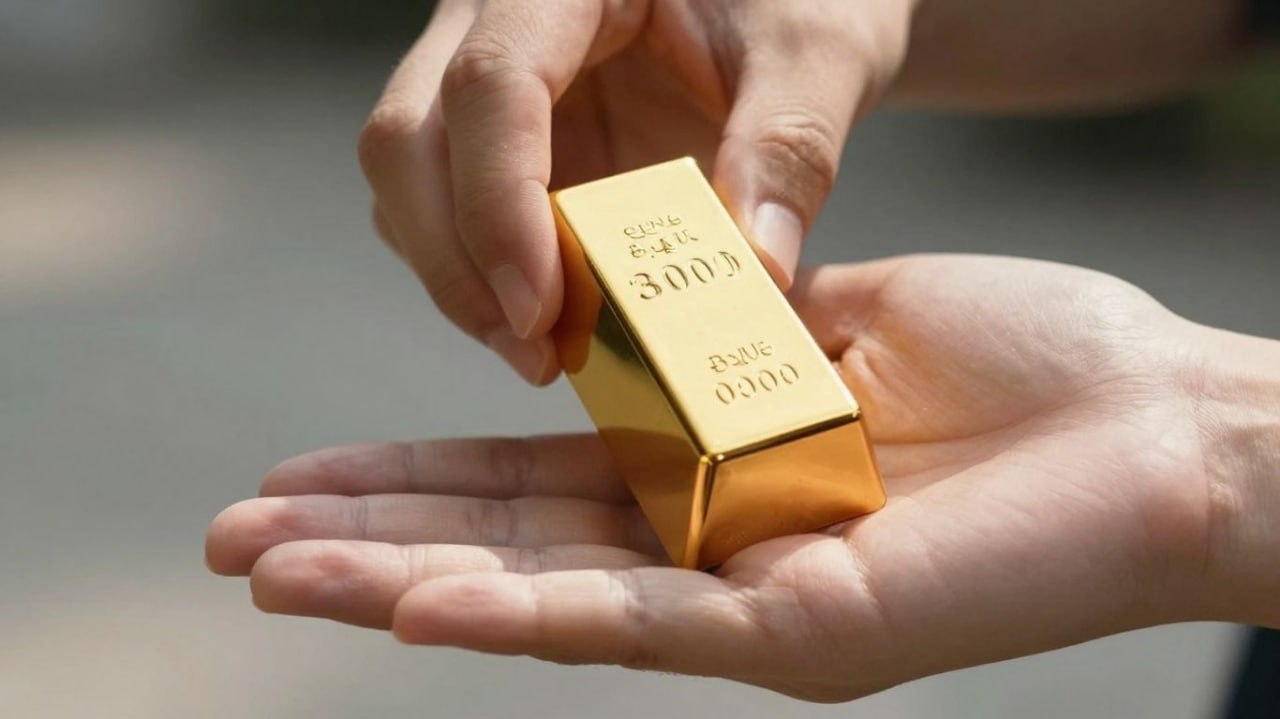
Prices for standard gold bars issued by the National Bank of Tajikistan (NBT) fell by an average of about 14% in March 2026, according to data from the regulator.
NBT data show that the price of a 5-gram gold bar declined from 8,132.52 somoni on February 28 to 7,003.24 somoni on March 30. A similar trend was observed across other weight categories.
The price of a 10-gram bar dropped from 16,143.12 to 13,884.56 somoni, while a 20-gram bar fell from 32,152.81 to 27,635.70 somoni.
Larger bars also recorded comparable declines: 50-gram bars decreased from 80,164.96 to 68,872.19 somoni, and 100-gram bars from 160,254.77 to 137,669.22 somoni.
Overall, gold prices declined by around 14% across all weights.
Price decline in March (February 28 – March 30)
|
Weight |
Was (somoni) |
Became (somoni) |
Decrease |
Decrease (%) |
|---|---|---|---|---|
|
5 g |
8132.52 |
7003.24 |
-1129.28 |
-13.9% |
|
10 g |
16143.12 |
13884.56 |
-2258.56 |
-14.0% |
|
20 g |
32152.81 |
27635.70 |
-4517.11 |
-14.1% |
|
50 g |
80164.96 |
68872.19 |
-11292.77 |
-14.1% |
|
100 g |
160254.77 |
137669.22 |
-22585.55 |
-14.1% |
Chart: Asia-Plus
Source: National Bank of Tajikistan (NBT)
The decrease affected both selling and buyback prices, indicating a broad decline in gold value rather than changes in bank pricing policies.
Economist Farrukh Nabiyev said the trend is likely linked to a correction in global gold prices following earlier gains.
“For the local market, this means that gold bar prices closely follow global trends,” he noted.
According to Nabiyev, the price drop could signal a buying opportunity for investors.
“Traditionally, demand for gold increases during periods of instability. If prices stabilize or begin to rise, those who buy now may benefit,” he said.
He added that interest in gold could grow, particularly among those who view it as a safe-haven asset.
According to the NBT, after a sharp 43% increase in gold bar prices in 2020, prices declined by 4.1% in 2021 and 9% in 2022. They then rose by 21.5% in 2023, 25.8% in 2024, and nearly 40% in 2025.
The National Bank of Tajikistan began issuing refined gold bars for open circulation in June 2017. They can be purchased by any citizen without restriction.
Prices are set daily based on the London morning gold fixing for a troy ounce (31.1034768 grams), taking into account production, transportation, insurance, and customs costs. The gold used is sourced domestically.
Market paradox: gold falls amid geopolitical tensions
March marked a rare case where, despite heightened geopolitical tensions in the Middle East, gold prices declined rather than increased. According to RBC, prices have fallen by 14–20% since the escalation began, despite gold’s traditional role as a safe-haven asset.
Analysts attribute this to a shift in investor preference toward other assets, particularly the U.S. dollar and oil. Rising oil prices have boosted inflation expectations and strengthened the dollar, reducing gold’s appeal, Reuters reported.
Experts believe the decline represents a correction following record highs rather than a reversal of the long-term trend.
Key support factors remain in place, including strong demand from central banks, which continues to exceed historical averages. Geopolitical uncertainty and gold’s safe-haven status also continue to support investor interest.
However, analysts warn that the market may remain volatile in the short term, as gold prices are sensitive to speculative activity, U.S. Federal Reserve policy, and movements in the dollar.
Key drivers behind the decline
RBC analysts cite several factors behind the drop in gold prices, including a correction after previous gains, a stronger U.S. dollar, rising oil prices amid Middle East tensions, and expectations regarding U.S. monetary policy.
Additional pressure came from profit-taking and speculative trading, which amplified the short-term decline in prices.