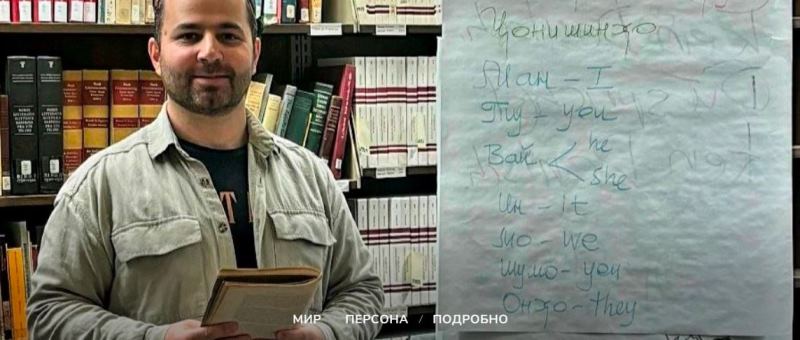
Teaching the Tajik language in Europe and the United States is not uncommon; however, in most universities it is taught as part of Persian and uses the Persian script. At the University of Kansas, Tajik is taught in its national form.
Bakhtiyor Davlatmurodov, a native of Tajikistan, teaches classes three times a week, each lasting one hour. He uses the textbook “Tajik for Foreigners” by renowned instructor Azim Baizoyev, as well as his own teaching materials. The course is offered under the title Survival Tajik.
In an interview with Asia-Plus, Davlatmurodov spoke about his career path and teaching experience in the United States.
An English teacher who teaches Tajik
By training, Davlatmurodov is a teacher trainer in English. In Tajikistan, he taught English to journalists through courses organized by the US Embassy in Dushanbe. He also served as a regional coordinator for the “English without Borders” project and worked with several organizations.
“Essentially, I am an English teacher, but I have a strong interest in teaching Tajik. My work goes beyond vocabulary and grammar—I introduce students to Tajik culture, art, traditions, and way of life,” he said.
According to him, some students aim to study Tajik at an advanced level. Their interest is driven by academic research, work in Central Asia, diplomacy, and volunteer activities.
He noted that one of his students, John, became interested in Tajik after hearing Tajik poetry, while another student, Milo, is studying the language out of cultural interest and plans to visit Tajikistan.
Interest in Language and Culture
Every Thursday, Davlatmurodov conducts open in-person sessions on Tajik culture, attended by 15 to 20 students.
One session focused on falak, a traditional musical genre from the Khatlon province, and his performance generated strong interest among students.
He also introduced participants to basic Tajik phrases during International Languages Day and performed a Pamiri dance at a “Hidden Culture” event, where more than 100 people joined in.
He plans to continue introducing students to the cultural diversity of Tajikistan’s regions.
According to him, foreigners are particularly drawn to Tajik hospitality, music, poetry, and the Navrouz holiday, which he sees as an opportunity to promote the language and culture.
“With growing interest in Central Asia, the study of Tajik will also expand, especially with more grant programs, qualified teachers, and high-quality educational materials,” he emphasized.
Tajik is taught at the University of Kansas under the Fulbright FLTA (Foreign Language Teaching Assistant) program, which typically lasts one academic year and aims to promote less commonly taught languages and cultures while developing teaching professionals.
A cultural ambassador
Davlatmurodov previously taught Tajik to staff at the Indian Embassy in Tajikistan and other foreigners. This experience helped him secure a place in the Fulbright FLTA program and become, in effect, a cultural ambassador of Tajikistan.
His responsibilities include teaching the language, representing the country, and organizing cultural events.
He grew up in a working-class family and developed an early interest in languages. He says he has a strong command of Tajik grammar and teaching methodology.
In March, he plans to organize a Tajik Culture Day at the university and has already begun preparations.
After completing the program, he intends to return to Tajikistan, share his experience with colleagues, and later pursue a PhD at the University of Kansas.