The recent suicide of a teenager in Kyrgyzstan has ignited a moral panic about the dangers of the Internet, and has prompted lawmakers to consider restricting the online activity of youngsters, EurasiaNet.org reports.
Within hours of news emerging that a young boy in the capital, Bishkek, had taken his life on February 1, media outlets began speculating about the pernicious effects of the Internet, and how interactive online games may have played a role in the tragedy.
Since then, police officers have been subjecting children to unauthorized physical inspections to ensure they are not self-harming. Officers are also checking children’s smartphones for potentially incriminating evidence.
The current wave of panic about online games actually preceded the Bishkek suicide by a couple of days. Within a two-day period, on January 30-31, multiple local outlets published detailed reports of the emergence of virtual games propagated by the use of Russian language hashtags, translatable as “#SeaOfWhales,” “#BlueWhales,” “#WhalesSwimUpwards” and “#WakeMeUpAt420.”
Media accounts described the game along these lines: anonymous administrators give participants, or “whales,” a series of bizarre real-life tasks, such as drawing a blue whale on one’s wrist and then photographing the result as evidence. Subsequent tasks would escalate in elaborateness. The games are said to be played through closed groups such as Russia-based social networking website VKontakte, or image-sharing site Instagram.
The #WakeMeUpAt420 hashtag alluded to in media reports developed an eerie relevance after the February 1 suicide, when police revealed that the victim had taken his life by leaping from the fifth floor of a Soviet-era apartment block at 4 am. No firm link has yet been established between the suicide and the purported online games.
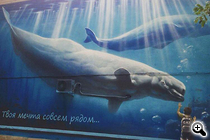
In a strange turn of events, the first casualty to follow that death was a much-loved piece of street art depicting a Beluga whale. A group of police officers turned up to inspect the mural, which covered a 100 square-meter space on the side of a travel agency, but took no immediate action. After darkness fell, however, a group of men with buckets of paint arrived to whitewash it.
The director of the travel agency later claimed to have ordered the whitewash of his own volition, although another employee told EurasiaNet.org on condition of anonymity that the police had made the suggestion.
On February 2, an MP affiliated with the Respublika-Ata-Jurt party, Maksat Sabirov, issued a call for lawmakers to somehow block access to websites propagating the games that have been linked to suicide. Other MPs have called for a ban on smartphones in school.
Police in Bishkek wasted no time in taking action. Law enforcement officers, accompanied by city and educational workers, raided Internet cafes on the evening of February 1 to check if there were any children present. Bishkek-based website KNews cited a police precinct in Bishkek as saying five underage children had been caught in a public park purportedly in the act of carrying out the tasks of an online game administrator. Even more sensationally, police claim to have intercepted a child in a state of intoxication in the act of trying to commit suicide, according to the KNews report.
Some observers are voicing concern that the current clamor around teenage suicide can have consequences for online freedom of expression. Burul Makenbaeva, director of the Bishkek-based Mental Health and Society nongovernmental organization, said the hype surrounding suspected suicide groups could provide authorities with an excuse to “clamp down on social networks.”
Regardless of the Internet’s role in the February 1 death, suicide is indeed a serious and seemingly deep-rooted problem in Kyrgyzstan, according to EurasiaNet.org.