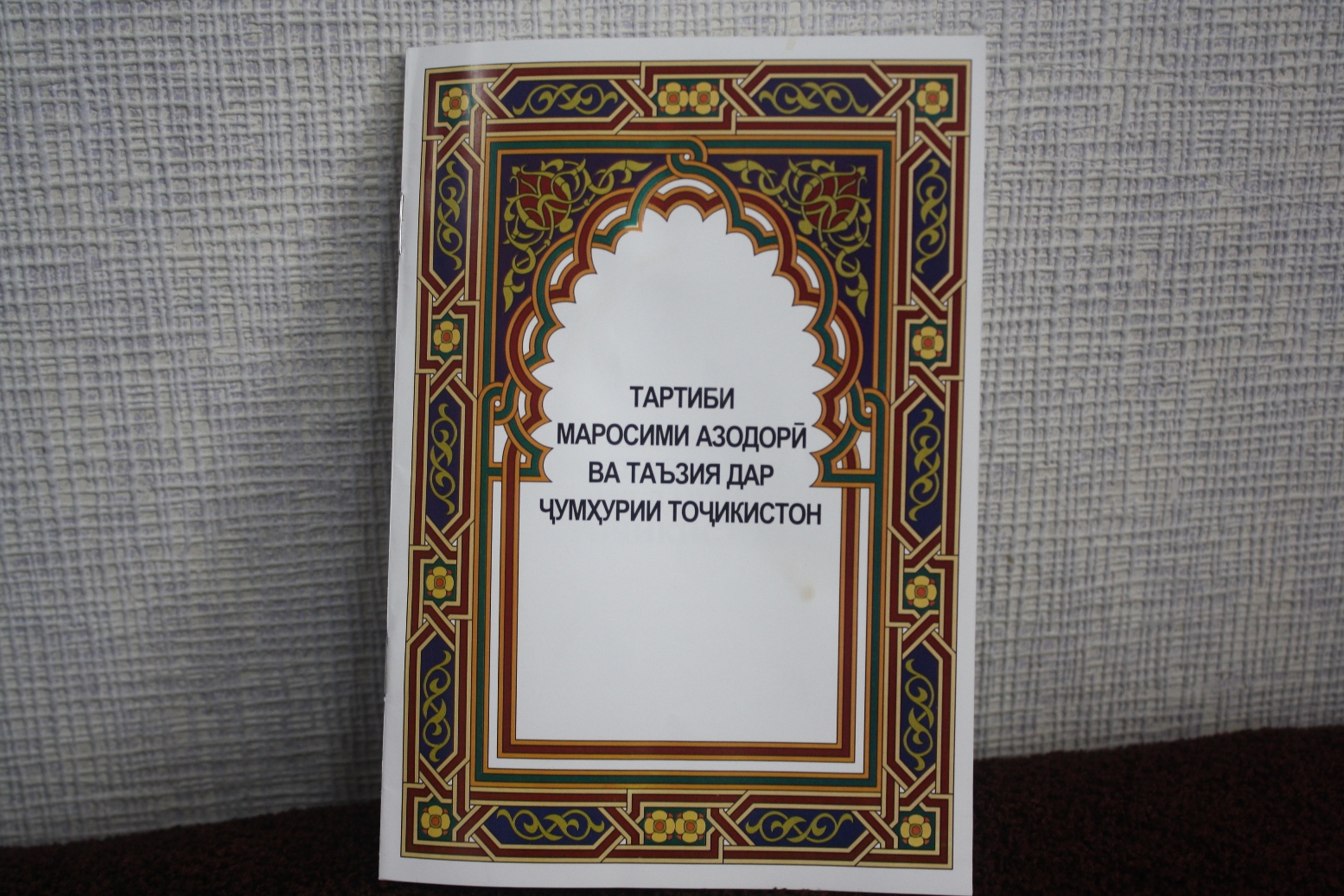
The Committee on Religious Affairs under the Government of Tajikistan together with the Council of Ulema Islamic (the country’s highest Islamic institution issuing fatwas and religious guidance to Islamic religious organizations) and the Center for Islamic Studies have published a brochure regulating funeral and mourning rites. 500,000 copies of the brochure were printed.
The brochure consists of eight parts.
Part 1, in particular, tells general rules of funeral and mourning ceremonies. It, in particular, notes that funeral and mourning rites must be carried out in accordance with the norms of the Hanafi madhhab (school), which is an official madhhab in Tajikistan, and Tajikistan’s legislation.
Part 2 describes the mourning ceremony and includes instruction on when the funeral prayer (janoza) should be performed, depending on when a person died.
Gravediggers’ fees are paid by the deceased relatives in the presence of the authorized persons.
Part 3 is about the preparation of the deceased for a funeral services (ablution, wrapping a body in a shroud, etc.).
It is prohibited to sprinkle earth on head and cry loudly at a funeral ceremony. It is also prohibited to order special mourners.
Only children and immediate relatives may stay in the deceased home in the night. The deceased immediate relatives may in mourning during three days.
Private feasts that commemorate the dead are restricted only to relatives of the deceased and it is not allowed to involve the slaughter of livestock.
Recall, Tajikistan's laws on religion restrict the locations of Islamic prayer and prohibit children under the age of 18 from taking part in public religious activities. Private religious ceremonies, including funerals and weddings, also are increasingly regulated by state officials.
Two provisions in the latest legislation would impose further restrictions on religious ceremonies. The bill outlaws celebrations marking the return of Muslims from hajj pilgrimages in Saudi Arabia. Private feasts that commemorate the dead also would be restricted only to relatives of the deceased and would not be allowed to involve the slaughter of livestock — a practice that currently is common.
Tajikistan’s government argues that its strict controls on religion are necessary to prevent the growth of what it calls Islamic "extremist" organizations and terrorist groups.
Religious groups banned in Tajikistan as "extremist" organizations include Salafis, the Muslim Brotherhood, the Islamic Movement of Uzbekistan, Islamic State (IS), Jindullah, Ansarrullah, and Hizb ut-Tahrir.
About 90 percent of Tajikistan's 8.3 million citizens are Muslims, and the majority are followers of the moderate Hanafi school of Sunni Islam.