

A new collection of verses in Shughni-Rushani language by known Tajik poet and journalist Sardor Rahdor (Dilbovarov) has been presented in Dushanbe.
The book-presentation ceremony took place at the Ismaili Center Dushanbe on November 4, on the occasion of the 63rd birthday of the poet.
The event was attended by politicians, diplomats, artistes, journalists and poetry lovers.
The book titled “Athuvjen Sozen” contains verses and poems in Shughni-Rushani language written by Sardor Rahdor in recent years as well as proverbs in Shughni-Rushani language.
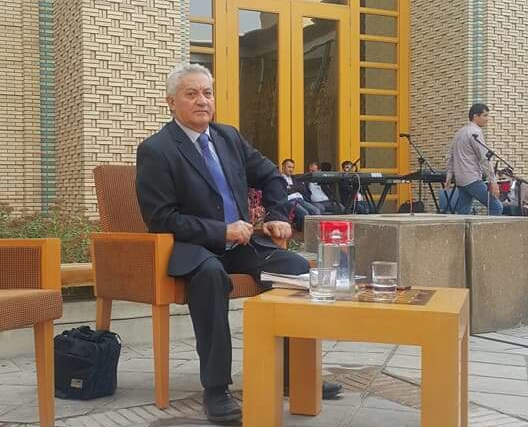
Sardor Rahdor was born in the Barrushon village of the Rushan district, Gorno-Badakhshan Autonomous Region (GBAO) on November 4, 1954. HE graduated from the Faculty of Tajik Philology at Tajik National University in 19972. He now works as senior journalist for Naqliyot (Transport) weekly, which is a mouthpiece of Tajik Railways (Tajik state railway company).
The Shughni language (including the dialects of Rushani, Oroshani, Bartangi, Oroshor, Khufi, and Shughni) along with Sarikoli, and Yazgulyam languages belongs to the Shughni-Sarikoli-Yazgulami sub-branch of the Pamir languages. Its distribution is in the Gorno-Badakhshan Autonomous Region in Tajikistan and Badakhshan Province in Afghanistan.
The Pamir languages are a subgroup of the Eastern Iranian languages, spoken by numerous people in the Pamir Mountains, primarily along the Panj River and its tributaries. This includes the Badakhshan Province of northeastern Afghanistan and the Gorno-Badakhshan Autonomous Region of Tajikistan. Smaller communities can be found in the adjacent areas of Pakistan where many have settled in recent decades.
The first published data concerning the Shughni language appeared in an article by R. Shaw "On the Shighni (Ghalchah) Dialect" (Journal of the Asiatic Society of Bengal, vol. 46, 1877).
A Shughni script was created in 1930/31 on the basis of the Latin alphabet. A number of textbooks and teaching devices were compiled for primary schools and some of them were even published. However, the Shughnis were only able to benefit from native language schooling for a few years.