

The second unit of Roghun hydroelectric power plant (HPP) is expected to be introduced into operation in early September this year.
Addressing a meeting in the Rasht district (eastern Tajikistan) on the occasion of Tajikistan’s Independence Day, President Emomali Rahmon noted on June 26 that they intend to introduce the second unit of the Roghun hydropower plant into operation in the days of the 28th anniversary of Tajikistan’s Independence (September 9).
According to him, introducing the second unit of the Roghun hydropower plant into operation will one more sustainable step to providing the country’s energy independence “that will a wide road for the fourth national goal – industrialization of Tajikistan.”
Recall, the second unit of the Roghun hydroelectric power plant has operated at idle since March 31. According to the official website of Ukraine’s Dnepr-Spetsgidromontazh, installation of Roghun hydropower plant’s second unit has been successfully completed. The unit was reportedly launched in a test mode on May 31 and it is still running at idle without generating electricity.
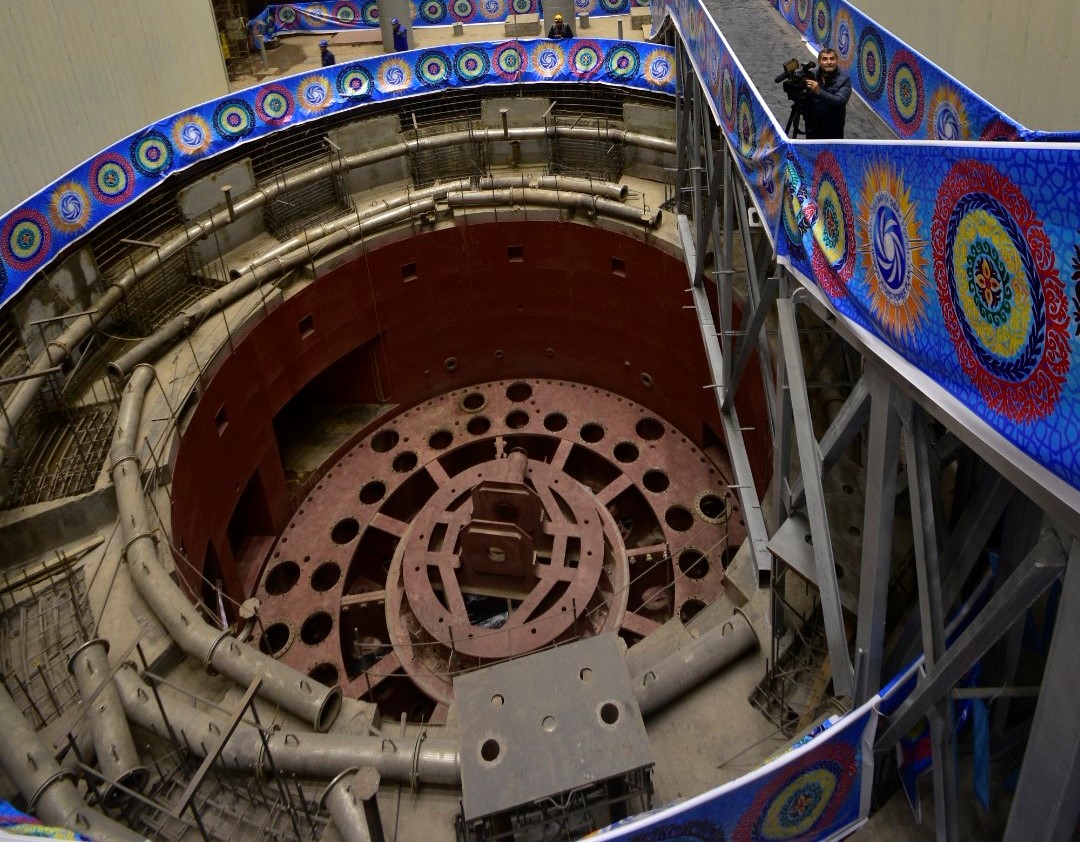
The first unit (Unit 6) of the power plant has also been assembled and installed by this Ukrainian company and Open Joint-Stock Company (OJSC) NBO Roghun has expressed gratitude to specialists of Dnepr-Spetsgidromontazh for good work.
The launch of the second unit of the Roghun hydroelectric power plant (HPP) into operation that was scheduled to take place in April this year has been postponed to a later date.
The Roghun HPP’s first of six units was officially switched on November 16, 2016.
Tajikistan stemmed the flow of the Vakhsh River for construction of the Roghun HPP in late October 2016.
Roghun HPP is an embankment dam in the preliminary stages of construction on the Vakhsh River in southern Tajikistan. It is one of the planned hydroelectric power plants of Vakhsh Cascade.
The Roghun HPP was first proposed in 1959 and a technical scheme was developed by 1965. Construction began in 1976 but the project was frozen after the collapse of the Soviet Union.
An agreement on finishing the construction was signed between Tajikistan and Russia in 1994; however, as the agreement was not implemented, it was denounced by Tajikistan parliament.
In October 2004, Tajikistan signed an agreement with Russia's RusAl aluminum company, according to which RusAl agreed to complete the Roghun facility and rebuild the Tursunzoda aluminum smelter. In August 2007, Tajikistan formally revoked a contract with RusAl, accusing it of failing to fulfill the contract.
In April 2008, Tajikistan founded OJSC NBO Roghun with an authorized capital of 116 million somoni for completing the construction of the Roghun HPP. Current authorized capital of OJSC NBO Roghun reportedly amounts to more than 12 billion somoni.
To raise funds to complete construction of the Roghun HPP the government started to sell shares in Roghun to people on January 6, 2010. Tajikistan has reportedly issued 6 billion somoni worth of Roghun shares. The sale of Roghun shares has reportedly earned the government 980 million somoni.
Tajikistan issued its first Eurobond in 2017 to help finance the project, which will include the world’s tallest dame when it is completed in 2026.
Italy’s Salini Impregilo won a $3.9 billion contract, making it the biggest single investment in Tajikistan since it gained independence in 1991.
At the November 16 launch of the first unit, the dam on the Vakhsh River was just 75 meters tall. If built as planned, the dam will rise to 335 meters by 2026 and will have six units with installed capacity of 3,600 megawatts (MW).
Uzbekistan, which lies downstream, previously voiced concerns about the impact on the water flows to Uzbek farmers. But Uzbek President Shavkat Mirziyoyev, who took power after Islam Karimov died in 2016, has softened Tashkent’s stance and eased tensions.
The government hopes the Roghun hydropower plant will help end power rationing in winter months while also allowing Tajikistan to boost energy exports to its neighbors, such as Uzbekistan and Afghanistan.



