
In Tajikistan, electricity rate for residential customers has risen 2.5 times in the national currency, the somoni, over a decade from 2010 to 2019 – from 9 diram per 1 KWh in January 2010 to 22.66 diram in September 2010.
The exchange rate of the somoni against the dollar has fallen 2.6 times against the dollar since 2010 – from 4.3:1 in January 2010 to 11.3:1 in January 2021.
In economic terms, electricity is a commodity capable of being bought, sold, and traded. Market operators do not clear trades but often require knowledge of the trade in order to maintain generation and load balance. The commodities within an electric market generally consist of two types: power and energy.
Last year, the government has refrained from raising utility (water and electricity supplies) and public transport rates due to the coronavirus pandemic.
Tajik authorities have justified their decision to raise electricity rates by saying that If they fail to raise rates gradually, it won't be possible to recoup the investments the government is making to build hydroelectric stations and power transmission lines
Besides, the authorities justified their decision to raise electricity rates by recommendations of international financial institutions.
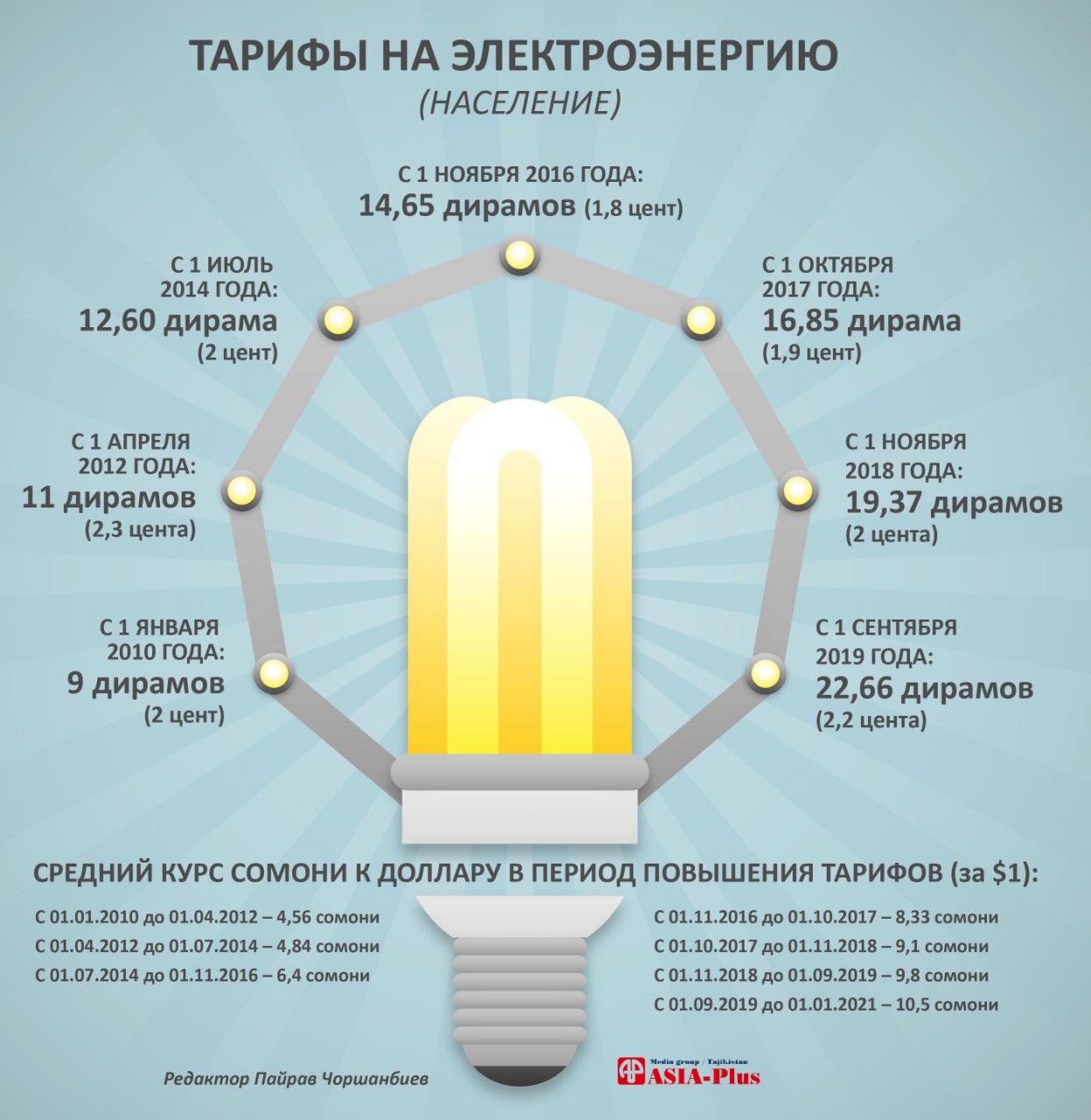
For the last time, the Tajik government raised electricity rates on September 1, 2019. Electricity rates rose for all categories of electricity consumers, with the exception of the Tajik Aluminum Company (TALCO). Thus, electricity rates for residential customers rose nearly 17 percent.
Current prices for 1 kWh of electricity in Tajikistan are 22.66 diram for residential customers, 55.14 diram for industrial and non-industrial customers, and 22.66 diram for federally funded institutions, including public utilities and sports complexes,
Electricity rates for pumping stations for mechanized irrigation and repair-and-production bases of the Agency for Land Reclamation and Irrigation under the Government of Tajikistan rose to 7.86 diram per 1 kWh for the period from April 1 to September 30 and to 22.66 diram per 1 kWh for the period from October 1 to March 31. The price of one KWh of electricity for vertical drainage wells and land reclamation pumping stations was raised to 7.87 diram.
The Tajik metallurgical plant currently pays 9.68 diram per 1 kWh during the period from April 1 to September 30 and 55.14 diram per 1 kWh during the period from October 1 to March 31.
Meanwhile, prices for TALCO, which is the largest electricity consumer in the country, remains unchanged – 7.20 diram for period from May 1 to September 30 and 11.80 diram for the period from October 1 to April 30.
In 2019, customer spending on electricity in Tajikistan was the highest in the Europe and Central Asia (ECA) region. Residents of Tajikistan spend on electricity on average nearly one-fifth of their monthly incomes.
The Program on Financial Recovery of Barqi Tojik (Tajikistan’s state-owned power utility), in particular, noted that during heating season the poorest households in rural areas in 2019 spent on average nearly 25 percent of their monthly incomes on electricity.
Residential customers in Dushanbe reportedly spend on average up to 15 percent of their monthly incomes on electricity in winter time in 2019.
In summer time, residential customers in rural areas and Dushanbe in 2019 spent on electricity on average 14 and 10 percent of their monthly incomes, respectively, the report said, noting that customer sending on electricity in Tajikistan was “the highest in the Europe and Central Asia (ECA) region.”
Barqi Tojik, however, states on each rise in electricity prices in the country that electricity rates in Tajikistan are the lowest within the CIS area.



