
An average market exchange rate of the Russian ruble (RR) in Tajikistan against the Tajik national currency, the somonis, has fallen more than 28 percent over the past four days – from 1:0128 on February 24 to 1:0.1.
The lowest market exchange rate was reported in one of brunches of Amonatbonk (Tajikistan’s savings bank) in Dushanbe – 1:0.095.
The highest market exchange rate was reported in Spitamen Bank – 1:01025
As far as the official exchange rate of the Russian ruble in Tajikistan is concerned, it increased from 1:0.133 on February 25 to 1:0.1365 on February 28.
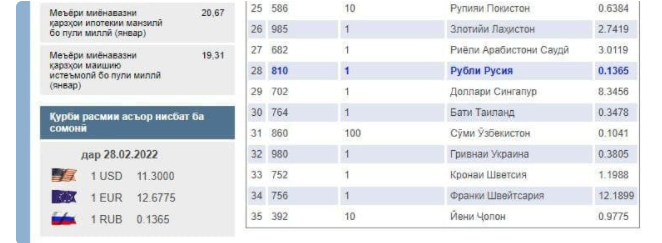
Meanwhile, during the last week, the official exchange rate of the Russian ruble against the somonis fell 10.7 percent – from 1:0149 on February 21 to 1:0133 on February 25.
The official exchange rate is the rate of exchange announced by a country's foreign exchange administration, usually used by countries with strict foreign exchange controls.
The market exchange rate refers to the real exchange rate for trading foreign exchange in the free market.
Volatility of the Russian ruble is usually linked to the international prices for hydrocarbons and fluctuations in the RR exchange rate are caused by a decline in global benchmark prices for hydrocarbons.
However, the current collapse of the Russian ruble and the Russian stock market downturn are explained by the increased geopolitical tensions present for Ukraine.
Geopolitical tensions have worsened this week, after Russian President Vladimir Putin made the decision to hold a special military operation in Ukraine in response to the address of leaders of Donbass republics.
Experts say the Western sanctions imposed on Russia over the Ukraine crisis will put economic strain on many smaller countries with close economic ties to the Russian Federation.
One of those countries is Tajikistan.
Even before the recognition announcement by the Kremlin, the international financial ratings agency Moody's put Tajikistan — along with Armenia, Belarus, Kyrgyzstan and Moldova — on a list of countries most likely to be affected by sanctions on Russia.
A study by Moody’s in particular, says that if sanctions are imposed, they will affect the CIS countries, which have close economic, financial, and energy ties with Russia through various channels.
Experts note that if RR devalues significantly, the currencies in Central Asia’s nations will also depreciate.
One of the first economic measures in Tajikistan that will be hit due to sanctions against Moscow are the many millions of dollars in remittances from the estimated more than 1 million Tajik labor migrants working in the Russian Federation.
In Russia, an official exchange rate of the Russian Ruble against the U.S. dollar set for February 28 is 85.0888:1.00.
Meanwhile, CNBC says the Russian ruble dived around 29% against the U.S. dollar on February 28 in an all-time low as markets assessed the impact of sanctions on Russia amid a growing backlash against Russia’s invasion of Ukraine. The ruble was reportedly trading as low as 119 per dollar as offshore trading started in the morning of February 28 during Asia hours, from nearly 84 per dollar the previous close. The ruble later pared some losses and last traded at 105.27 during Asian afternoon hours.



