CABAR.asia says the problem of land falling out of crop rotation has become increasingly acute in Tajikistan’s agricultural regions in recent years. Experts discuss water scarcity and management failures, while farmers expect negative consequences in the coming years.
During a meeting with the Khatlon region’s leaders on May 25 this year, President Emomali Rahmon said that almost 900 hectares of irrigated land in the region had fallen out of crop rotation. He expressed concern about the stagnation of arable land for various reasons, including the breakdowns of water pumping stations.
Given Tajikistan’s arid climate, the main reasons for the arable land falling out of crop rotation is the lack of irrigation water and breakdowns of water pumping stations.
According to the State Committee on Land Management and Geodesy of Tajikistan, about 4865.84 hectares of land fell out of crop rotation in 2023. This is 11 % (581.65 hectares) more than in 2022.
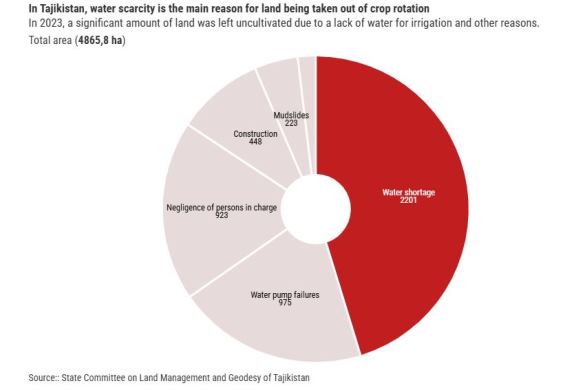
Problems with watering of irrigated lands in Tajikistan
In some areas of northern Tajikistan, hundreds of hectares of land are not used due to a lack of irrigation water.
The water supply in those areas is unpredictable: from the beginning of June to September, water is supplied irregularly.
Since the hot weather starts in May, it burns all the crops. The northern district of Istaravshan is one of the driest districts in the country, besides being the windiest in the country.
Another reason for land remaining uncultivated is the failure of the water distribution system and facilities. Due to non-operational pumping stations, 975.96 hectares of land remained uncultivated in the country in 2023.
Water scarcity threatens agricultural development in Tajikistan
According to Tajikistan’s State Committee for Land Management and Geodesy, the most land fell out of crop rotation in the Sughd province. Last year, 2,969.61 hectares of land in this region reportedly remained uncultivated due to a lack of irrigation water.
The problem is most acute in Zafarobod and Mastchoh districts. These two districts were founded in the 1950s for agricultural development.
In Zafarobod district, 195.03 hectares of land remained uncultivated due to the failure of water pumping stations and another 566.91 hectares – due to lack of water.
Even though Istaravshan brought 238 hectares of uncultivated land back into use in 2023, it still ranks third in the region in terms of uncultivated land. In Istaravshan, 286 hectares of land are not cultivated due to the failure of water pumping stations, and 200 hectares – due to mistakes made by economic entities.
Why has fertile land stopped yielding crops?
In the Khatlon province, hundreds of hectares of land have also fallen out of crop rotation and become unusable.
Some local farmers say that part of their agricultural lands is already unusable. They fear that if this situation continues for another two or three years, the rest of their lands will become unusable for agriculture.
According to the State Committee for Land Management and Geodesy, the irrigation water situation is worsening every year due to climate change, which is becoming a big problem.
In the Khatlon province in 2023, 462.04 hectares stopped being cultivated due to a lack of water for irrigation. This is about 50% of the total land that has fallen out of crop rotation.
Other reasons for arable land out of crop rotation in this region are breakdowns of water pumping stations, floods, mudslides, and poor agricultural practices.
Experts also connect land degradation processes to climate change, rising temperatures, and mistakes of economic entities.
Journalist Saifiddin Qarayev, who has been reporting on this issue for many years, believes that the main reason for the degradation of agricultural land is poor management, including the use of agricultural technologies. There is also a water shortage problem in several districts.
According to him, farmers do not plan their work.
“They plant the same crop in the same place year after year. This will surely not produce a good harvest. If a farmer owns 5 hectares of land, he should let one hectare of land rest every year. The land is tired, there are no conditions for good harvests,” Qarayev said.




