An article by Chris Rickleton, Central Asia Correspondent, Radio Liberty, notes that ensuring that any dissatisfaction over the state border agreement between Kyrgyzstan and Tajikistan is contained will be a key priority of the Kyrgyz government ahead of ratification.
But it has had some practice on this front, he said, noting that in 2022, opposition to a theoretically less contentious border deal with Uzbekistan marked the first real challenge to Japarov’s regime, which took a decidedly authoritarian turn thereafter.
“Dozens were arrested in that crackdown, demonstrating a new “red line” for political opposition.”
According to him, a challenge to the Tajik government over something like a border agreement seems almost impossible. Over the last decade, political opposition in the country has reportedly been completely wiped out.
But if deepening authoritarianism is one trend in Central Asia, an increasing emphasis on cooperation between the region’s countries is a more positive one, generally occurring without any outside assistance, Mr. Rickleton noted.
Along with “neutral roads” in no-man’s-land, the Kyrgyz-Tajik border agreement has reportedly created a framework for sharing water from the Golovnoi intake facility that draws water from a river known as Ak-Suu by Kyrgyzstan and Isfara by Tajikistan.
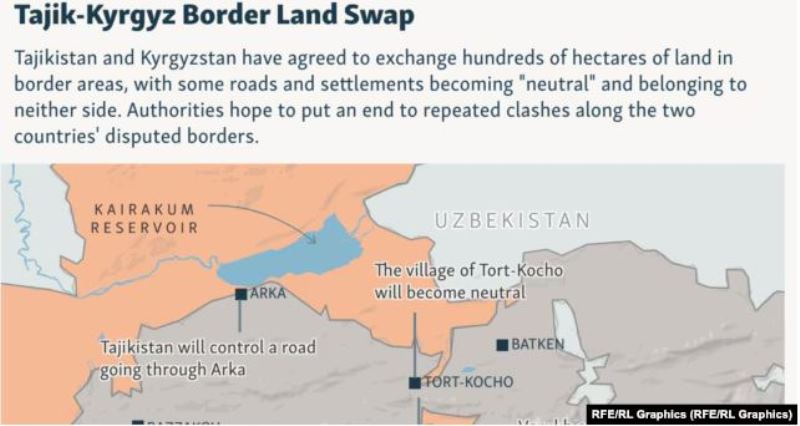
Tajiks and Kyrgyz already share water from the sluice, but it was another site of contention, most notably during the three-day border war of 2021. Under the new agreement, each side will have a gate each at the intake and split the third one.
How these and other shared infrastructure are managed in practice remains to be seen.
The journalist believes that the two countries’ transition from foes to friends is likely to be further cemented at an unprecedented trilateral summit with Uzbekistan in the Tajik city of Khujand on March 31.
He notes that for both countries, Uzbekistan was once a nightmare neighbor, but that has reportedly completely changed ever since President Shavkat Mirziyoev replaced the late Islam Karimov as leader of Uzbekistan, viewing the neighborhood through the prism of opportunities, rather than threats, and moving quickly to end his own country’s border disputes.