On Friday May 16, during a working visit to Danghara district, President Emomali Rahmon inaugurated the construction of the second phase of the Sipar Group (Shield Group) plant — a facility for assembling and manufacturing armored personnel carriers and other military equipment.
The Tajik president’s official website says the foundation stone was laid in the village named after Ismat Sharifi. The total area of the industrial zone where the plant will be located is 40 hectares.
The enterprise is expected to partially meet the country’s demand for military equipment through domestic production.
President Rahmon reportedly gave specific instructions to industry officials and the company’s management regarding the increase in production volumes, ensuring that the equipment meets modern standards, and organizing the training of local specialists.
In addition, in the village of Korez, the president laid the foundation stone for a new plant by "Kurushi Kabir Industry" for the production of doors, windows, and aluminum panels. According to government sources, the facility will cover 12,000 square meters and include two production lines, with an annual capacity of 180,000 units of finished products.
It is worth noting that the first phase of the Sipar Group plant was launched in 2023 in the city of Tursunzoda (western Tajikistan).
As part of his working visit to the city of Tursunzoda, President Emomali Rahmon on May 24, 2023 attended an official opening ceremony of a military vehicle assembly plant, Sipar Group.
The activities of this newly established enterprise appear mainly geared toward producing military automobiles, although it has capacity to build civilian vehicles too.
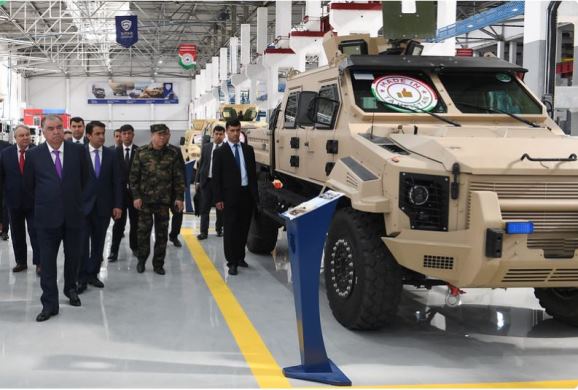
According to the Tajik president’s official website, Sipar Guruh enterprise was established within the framework of the Years of Industrial Development (2022 – 2026) and the implementation of the goals of the National Transport Complex Development Program for 2025.
At that time, the company began assembling 17 types of special-purpose vehicles using imported components, with an annual capacity of 120 units. The assembled vehicles were supplied to the Tajik Armed Forces, with plans for future export.
Tajikistan’s Minister of Industry and New Technologies, Sherali Kabir, had previously stated that the armored vehicles produced in Tajikistan are on par with those manufactured in Uzbekistan and Kazakhstan. According to Kabir, production is based on Canadian technology and uses high-quality metal sourced within the country.




