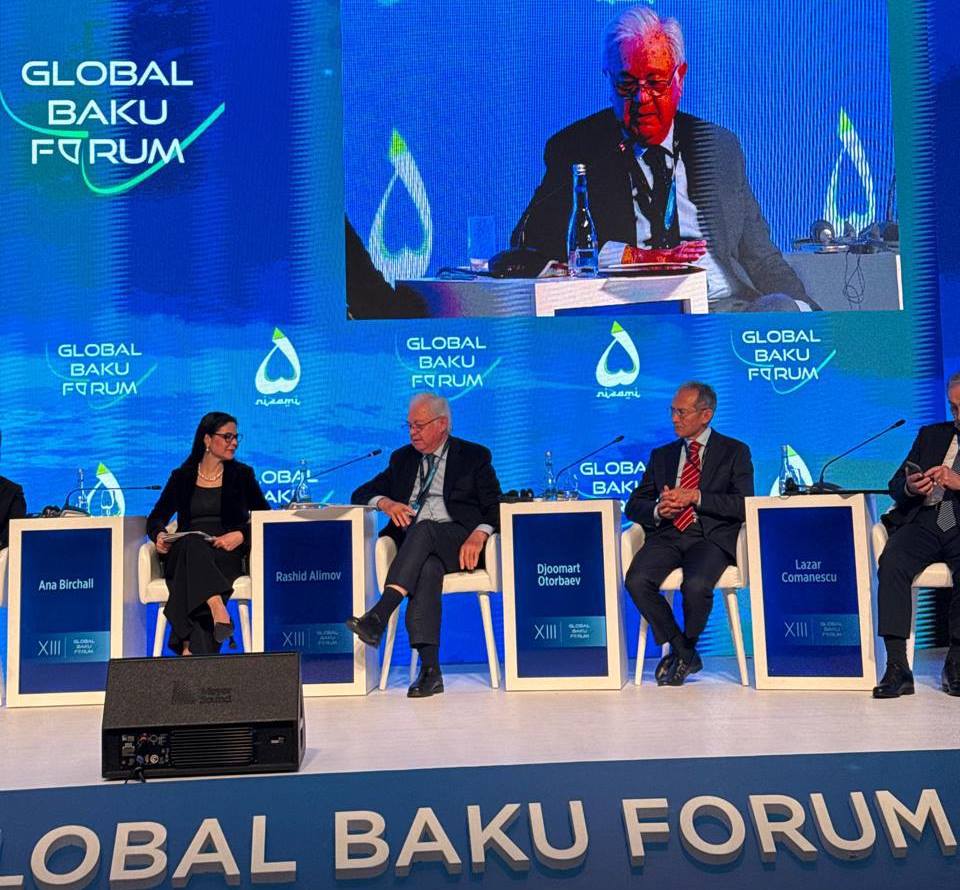
At the XIII Global Baku Forum, held in Azerbaijan’s capital on March 12-14, politicians, scientists, diplomats, and public figures from over 60 countries gathered to discuss a range of global issues. Tajikistan was represented at the event by Rashid Alimov, a professor at the Academy of Public Administration under the President of Tajikistan.
One of the key discussions at the forum focused on the future development of the Middle Corridor Transport Route and the Eurasia Connection Gateway initiative.
In his speech, Alimov presented an analytical perspective on the role of Eurasian transport routes in strengthening economic connectivity across the Eurasian continent.
The Baku Forum program included 12 panel sessions addressing the most pressing contemporary issues, from security and energy concerns to sustainable development, transport connectivity, and technological transformations.
The participants discussed one of the most challenging questions of today’s international agenda: how to overcome global divisions in a world undergoing a deep transitional period. Speakers acknowledged that the modern international system is in a state of strategic uncertainty. The world is no longer unipolar, but true multipolarity has not yet emerged.
According to the forum's speakers, international relations have entered a "transitional era," where fragmentation and growing competition among global powers increasingly define global politics. In this context, finding new forms of cooperation and crisis prevention mechanisms has become even more critical.
A key theme of the discussions was the belief that dialogue remains the only effective tool for conflict resolution and overcoming intergovernmental contradictions. Many participants emphasized the need to strengthen international institutions, build trust, and form pragmatic coalitions capable of addressing the challenges of a rapidly changing world.
The Global Baku Forum has been held in Azerbaijan since 2013. The forum is organized by the Nizami Ganjavi International Center, a non-governmental organization focused on fostering dialogue between cultures, enhancing mutual understanding, and facilitating the search for collective solutions to global problems.