
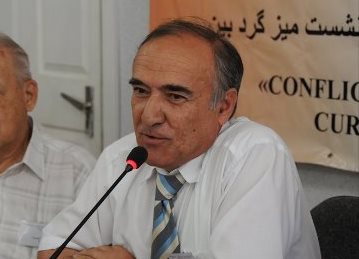
DUSHANBE, June 20, 2013, Asia-Plus — There ought not to expect that Afghan peace talks that are supposed to take place in Doha, Qatar will bring quick peace and accord to Afghanistan.
Qosimsho Iskandarov, Director of the Center for Afghanistan and Central Asian Studies, said this in an interview with Asia-Plus Thursday afternoon.
According to him, discord between various groups in Afghanistan has so deep roots that “is very difficult to establish peace and accord in this country.”
“There is no denying that the beginning of talks between representatives of the government Hamid Karzai and the Taliban is of significant importance, though the Taliban do not recognize the legitimacy of the current government of Afghanistan,” the expert stressed.
Iskandarov is convinced that opening of the Taliban office in Doha gives hope, “because the sides now know where they may apply to.”
Meanwhile, international sources have reported that hopes dimmed for Afghan peace talks when Afghan President Hamid Karzai on June 19 suspended security negotiations with the U.S. and scuttled a peace delegation to the Taliban.
An article entitled “U.S. Tries to Allay Karzai Anger over Taliban Peace Talks” that was posted on CBCNEWS’s website on June 19 notes that what provoked the mercurial Karzai and infuriated many other Afghans was a move by the Taliban to cast their new office in the Gulf nation of Qatar as a rival embassy.
On June 18, the Taliban held a ribbon-cutting ceremony, in which they hoisted their flag and a banner with the name they used while in power more than a decade ago: “Political Office of the Islamic Emirate of Afghanistan.”
U.S. Secretary of State John Kerry spoke with Karzai on the phone, telling him that his concerns were justified and that he would work to resolve the issue, CBCNEWS reports.
The Telegraph reported on June 20 that Hamid Karzai has plunged Afghan peace talks into doubt by threatening to boycott the process unless militants end their violence and the US pull out of negotiations, in protest at the raising of the Taliban flag over their office in Qatar.
Karzai said his High Peace Council would not enter talks with the Taliban until the negotiations were “completely Afghan.”
A statement released by the Presidential Palace said: “The latest developments show that foreign hands are behind the Taliban”s Qatar office and, unless they are purely Afghan-led, the High Peace Council will not participate in talks.”
According to The Telegraph, a palace official speaking on condition of anonymity, added: “The Islamic Emirate of Afghanistan doesn”t exist anywhere except in the imagination of the Taliban.”
We will recall that the international force is to be cut in half by the end of the year, and by the end of 2014 all combat troops are to leave and be replaced — contingent on Afghan governmental approval — by a smaller force that would be on hand for training and advising.
