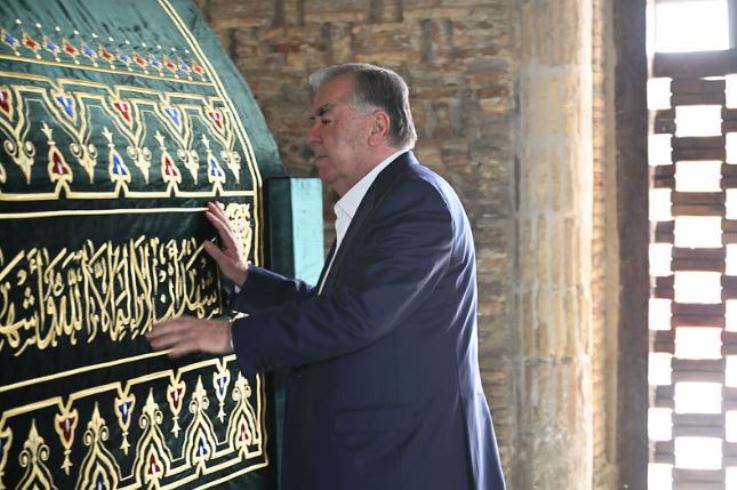
On March 27, President Emomali Rahmon of Tajikistan and President Shavkat Mirziyoyev of Uzbekistan jointly toured major historical landmarks in the ancient city of Bukhara as part of Rahmon’s state visit to Uzbekistan.
The Tajik president’s official website says the visit included stops at the Bukhara Fortress, the memorial complex and mausoleum of Bahauddin Naqshband, the Labi Hauz ensemble, the Poi Kalon architectural complex, and the Mausoleum of Ismoil Somoni.
Particular attention was given to the Samanid Mausoleum, an architectural monument dating back to the 9th–10th centuries. Widely regarded as a masterpiece of early Islamic architecture, the structure reflects the craftsmanship of its era.
According to historical accounts, the mausoleum was commissioned at the end of the 9th century by the prominent statesman Ismoil Somoni (849–907) over the burial site of his father, Ahmad ibn Asad. Ismoil Somoni himself, along with his son Nasr II and other members of the dynasty, are also buried there.
The square-shaped structure is crowned with a large dome and features decorative elements along its perimeter, including four corner towers that enhance both its architectural balance and structural strength.
The Samanid Mausoleum, also known as the Mausoleum of Ismoil Somoni, is one of the few structures to have fully survived from the Samanid period. It remains one of Bukhara’s most significant historical landmarks and a rare example of early Central Asian architecture.
The site is included in the ISESCO Cultural Heritage List and attracts hundreds of visitors from around the world each day.
During Tajikistan’s independence period, special recognition has been given to the legacy of Ismoil Somoni as a founder of Tajik statehood. In 1999, Tajikistan marked the 1100th anniversary of the Samanid state with national celebrations, including the unveiling of a monument to Ismoil Somoni in Dushanbe. The national currency, the somoni, and a district of the capital are also named in his honor.