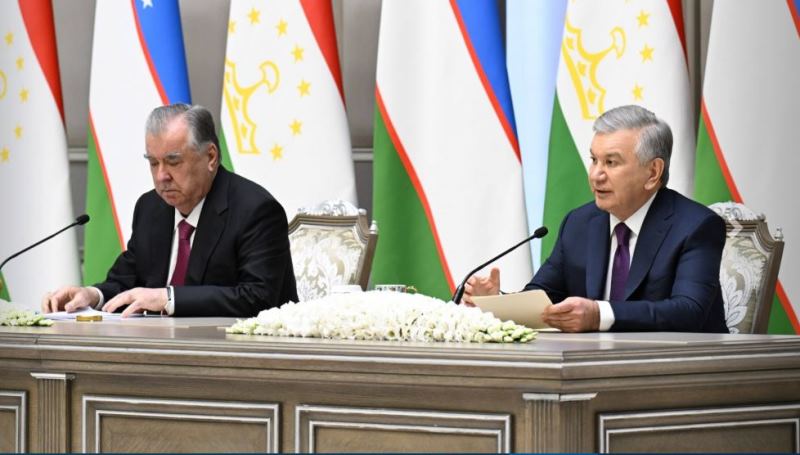
The presidents of Uzbekistan and Tajikistan, Shavkat Mirziyoyev and Emomali Rahmon, summarized the outcomes of high-level talks during a joint press briefing held at the Kuksaroy Residence on March 26, following the first meeting of the Supreme Interstate Council.
The Uzbek president’s press service reports that opening the briefing, President Mirziyoyev praised Tajikistan’s recent economic performance, highlighting steady growth, successful investment attraction, controlled inflation, and rising real incomes.
He reaffirmed that Tajikistan remains a reliable strategic partner and ally, noting that bilateral relations continue to develop dynamically across political, economic, and humanitarian spheres, underpinned by shared goals and mutual trust.
Both sides reportedly welcomed the regular engagement between parliaments, governments, regional leaders, and representatives of the intelligentsia. Trade between the two countries approached $1 billion last year, while industrial cooperation has expanded significantly, with more than 500 joint ventures operating in Uzbekistan.
Transport links have also strengthened, with ten weekly flights currently connecting the two capitals.
Mirziyoyev highlighted the extensive preparations leading up to the summit, including meetings of the intergovernmental commission, regional forums, and exchanges involving rectors, scientists, youth, and think tanks. Cultural initiatives such as the Days of Tajik Culture and Cinema were also successfully held.
During the talks and the inaugural session of the Supreme Interstate Council, the two leaders reportedly discussed a wide range of issues and identified key priorities for advancing their multifaceted partnership. They emphasized the importance of sustained engagement at all levels and closer coordination within regional and international platforms, including the Consultative Meetings format and “Central Asia Plus” initiatives.
Economic cooperation featured prominently on the agenda. The two governments were tasked with taking concrete steps to boost bilateral trade to $2 billion under a dedicated program. Plans include accelerating the establishment of the Oybek–Fotehobod trade zone and implementing a $2 billion cooperation program spanning energy, geology, metallurgy, textiles, agriculture, and pharmaceuticals.
The leaders also agreed to make active use of the Joint Investment Company to support these initiatives.
In the transport and transit sector, the sides signed an agreement on introducing an electronic permit system for freight transport and reached understandings on expanding air and rail connections, as well as increasing the capacity of border checkpoints.
They stressed that these measures are aimed at creating favorable conditions for businesses and citizens, while unlocking the economic potential of border regions.
Water and energy cooperation was identified as another strategic priority. Both countries expressed readiness to jointly advance major green energy projects and enhance coordination on water resource management, including the digitalization of water infrastructure.
Cultural and humanitarian ties were also highlighted as a key pillar of bilateral relations. Joint initiatives include the production of a film dedicated to the friendship between historical figures Abdurahmon Jomi and Alisher Navoi, as well as the naming of a street in New Tashkent after Dushanbe.
The two sides also agreed to expand exchanges in education, tourism, and youth programs, supported by an annual calendar of events. A comprehensive cooperation program will be developed to support diaspora communities, strengthen cultural centers, and preserve language and traditions.
Both leaders concluded that the outcomes of the visit would significantly strengthen allied relations and contribute to the long-term development and prosperity of both nations, according to the Uzbek president’s press service.