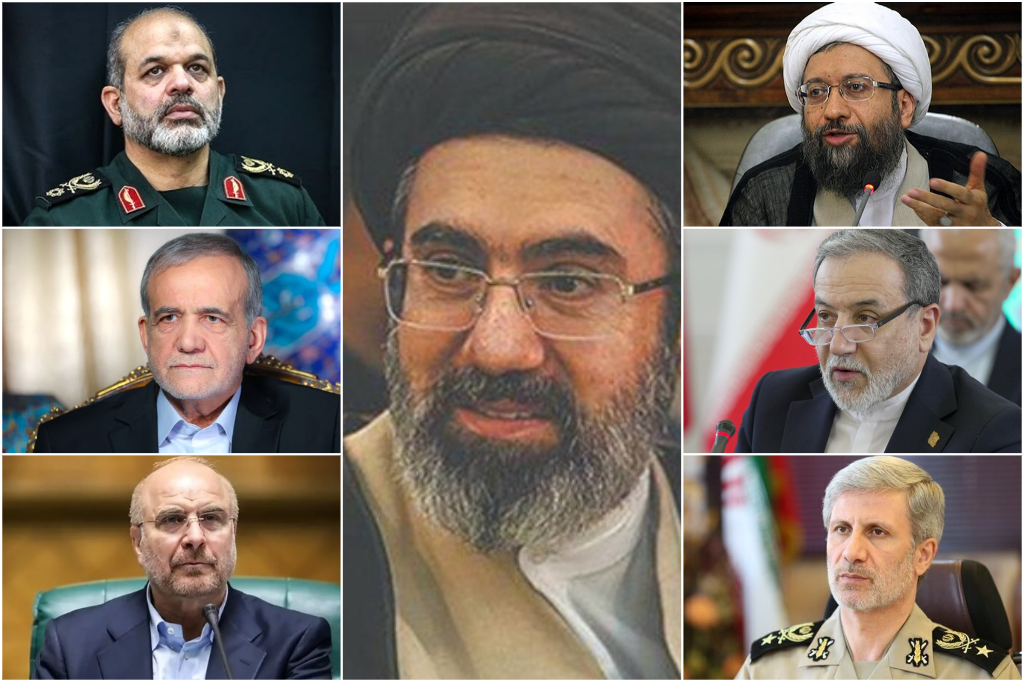
The assassination of a leader in Iran at the beginning of the war did not lead to the sudden collapse of the state system as many had expected. This is because a structure has formed in this country where power is increasingly concentrated in the hands of the military, and the decision-making center has shifted towards the security forces.
The current regime in Iran is built as an independent network so that if one of its parts suffers, others can continue their work without central leadership.
Let’s see who governs Iran today.
The Supreme National Security Council and the Defense Council of the country play a key role in coordinating defense and intelligence affairs.
Officially, Mojtaba Khamenei, the son of the deceased leader, was appointed as the new head and took control of the armed forces and key institutions. However, in practice, the extent of his real power remains unclear, as he has not appeared at public events since his appointment. According to the latest data, the new supreme leader of Iran is unconscious and unable to participate in decision-making by the Iranian leadership.
This situation has led to important managerial and military decisions being made by a broader circle of commanders and officials.
Among influential figures, Mohammad Baqer Ghalibaf acts as a mediator between the military, clergy, and security forces. International media report that his role is currently even greater than that of the country’s president, Masoud Pezeshkian.
The role of the commander of the Islamic Revolutionary Guard Corps (IRGC) and other high-ranking military commanders is also significant in governing the country.
The Islamic Revolutionary Guard Corps (IRGC) has always been a pillar of the regime, but during the war, its influence has increased even more. This organization, overseeing missile programs and overseas operations, now has a decisive say in strategic decisions regarding the war. The influence of the IRGC is exercised not through one person, but through an extensive network of high-ranking officers and like-minded politicians present throughout the state apparatus.
Other key figures shaping hidden processes include: Gholam Mohsen Ejei, Ahmad Vahidi, Ali Abdollahi, Ismail Qaani, and Ahmadreza Radan.
The role of President Masoud Pezeshkian and Foreign Minister Abbas Araghchi, although not as visible in strategic military decisions, is nevertheless important in the governance of the state and foreign policy.
So far, Iran has tried to minimize the damage from the US and Israeli strikes by appointing numerous successors for each high-ranking position. Despite several key figures being killed during the war, the military structure has maintained control of the country by replacing the deceased with new people.
The biggest blow to the regime was the assassination of Ali Khamenei. At the end of March, Alireza Tangsiri, the commander of the IRGC navy, was killed, with the latest high-ranking victim being the Head of the Intelligence Directorate of the Revolutionary Guard Majid Khademi.
See below who was killed and who took their positions.
To prevent a power vacuum, the country’s Defense Council was created, which took on the responsibility of centralized military decision-making after the elimination of key figures.
Overall, Iran has shifted from a centralized system to a management model where the main force is considered to be the IRGC, making the major decisions.