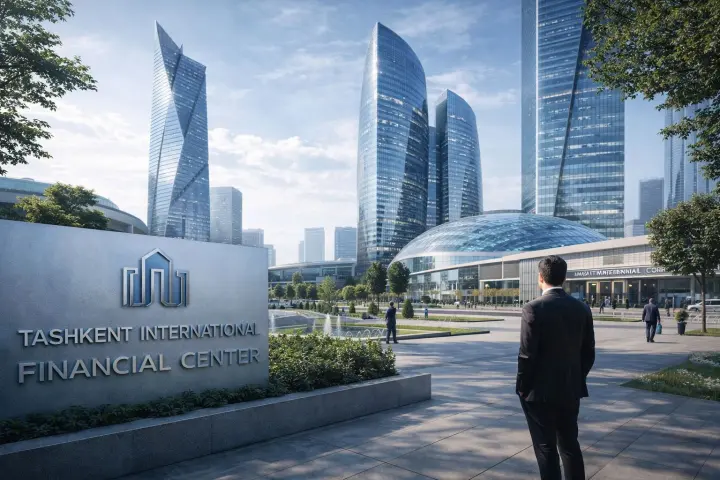
At the end of March 2026, the creation of the Tashkent International Financial Center (TIFC) was officially launched in Uzbekistan. The center is being established as a special financial jurisdiction with a separate regulatory regime aimed at attracting international capital and developing financial services.
On March 25, the President of Uzbekistan, Shavkat Mirziyoyev, became acquainted with a presentation on the creation of the Tashkent International Financial Center, the launch of the International Center for Digital Technologies, and the implementation of Islamic finance mechanisms in the banking system. This was reported by the press service of the head of state.
It is expected that within the framework of the TIFC, there will be its own system for regulating financial markets, as well as a specialized commercial court and arbitration based on common law norms (similar to existing centers in Dubai and Astana). This should increase the predictability and protection of investors’ rights in cross-border transactions, reports everyday.uz.
Uzbekistan’s Goals and Regional Context
For Uzbekistan, the creation of such a center is part of a long-term strategy: to strengthen Tashkent’s position as a financial hub of Central Asia, diversify funding sources, and expand the range of financial instruments (from traditional banking services to capital markets, Islamic and “green” financing, and digital assets).
The presence of several competing or complementary financial platforms in the region (Astana, Tashkent, and potentially other cities) changes the geography of capital flows.
It is easier for investors to work with a jurisdiction where a clear legal and judicial infrastructure is in place, procedures are standardized, and familiar international law operates.
Potential Effects for Tajikistan
For Tajikistan, the Tashkent center may have both indirect and direct impact. Indirectly — through increased investment activity in the region, and the growing interest of international financial institutions and private funds in Central Asia as a whole. Directly — through the participation of Tajik companies and banks in transactions structured via the TIFC.
The proximity of Tashkent and close economic ties between the two countries make the new center a potentially convenient platform for attracting capital to infrastructure, energy, transport, and digital projects involving Tajik partners. For a number of issuers and banks, using the regional hub may be cheaper and organizationally simpler than accessing more distant international platforms.
Opportunities for Business and Financial Sector of Tajikistan
For large and medium-sized businesses in Tajikistan, the TIFC theoretically opens several directions: placement of debt instruments (bonds, syndicated loans), participation in private equity funds and project financing, and working with Islamic and sustainable (ESG) financial instruments. This could become an alternative channel for attracting “long-term” resources.
For banks and fintech companies, new products and partnerships are of interest: cross-border payment solutions, services for servicing migration and trade flows, and joint digital platforms. The presence of a separate court and arbitration based on common law simplifies the structuring of complex deals and dispute resolution, which can be critical for cross-border projects involving Tajik companies.
Challenges and Tasks for Dushanbe
The emergence of a major financial hub in a neighboring country simultaneously intensifies competition for capital and sets a benchmark for the quality of the regulatory environment. For Dushanbe, this means the need to continue reforms related to improving the investment climate, digitalizing government services for businesses, and developing domestic financial markets.
Much will depend on whether Tajikistan can build a pragmatic model of interaction with the TIFC: using its tools and infrastructure without losing the potential for developing its own financial sector. In the optimal scenario, the Tashkent center becomes an additional channel for access to capital and expertise for the Tajik economy, rather than just a point of attraction for competing projects.