
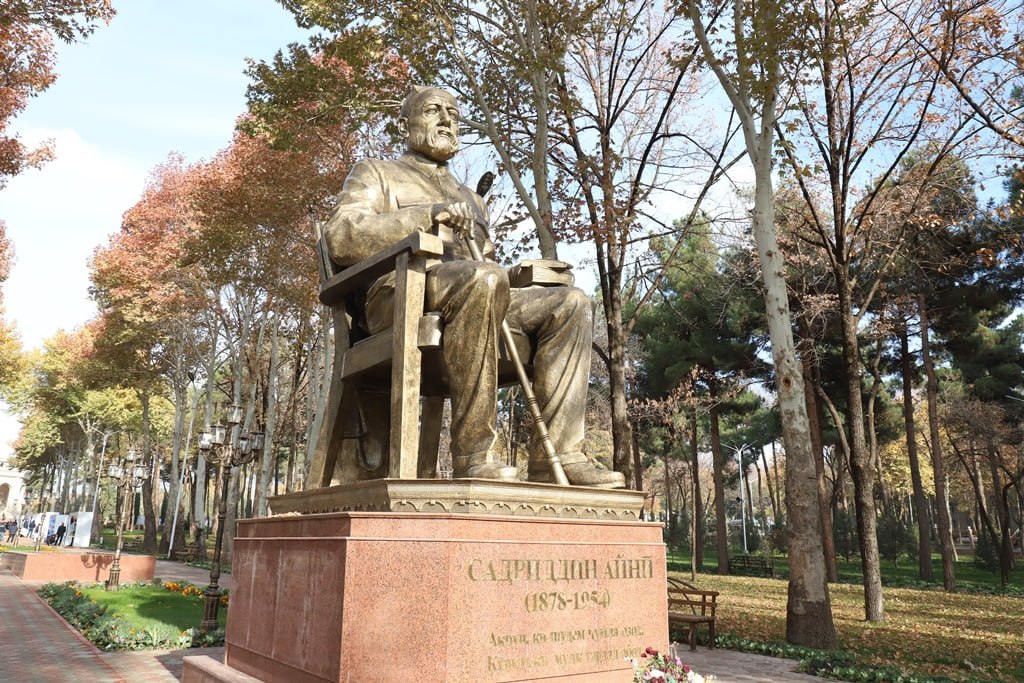
We prepared this story back in 2018 — for the 140th anniversary of Sadriddin Ayni — and today we want to share it again.
At that time, we spent almost a month searching for archival video and audio, then we conducted filming in two stages in Dushanbe and Samarkand, and also selected a suitable actor for the role of the famous writer and scholar.
The founder of Tajik Soviet literature, Sadriddin Ayni (real name — Sadriddin Said-Murodzoda), was born on April 15, 1878, in the village of Soktare, Gijduvan district of the Emirate of Bukhara, in a dehkan family.
Ayni was a distinguished figure in the sciences of the Tajik SSR (1940), an honorary member of the Academy of Sciences of the Uzbek SSR (1949), and a Doctor of Philological Sciences (1949). From 1951, he was the first president of the Academy of Sciences of the Tajik SSR. The first laureate of the State Prize of Tajikistan (1950).
In addition to his native Tajik, Sadriddin Ayni was well-versed in the Uzbek language, and he wrote some of his works in both languages. He made a significant contribution to the literature of both nations.
His main works include: “Odina” (published in 1924), “Dokhunda” (1930), “Slaves” (1934), “The Death of the Usurer” (1939), “Memoirs” (“Bukhara”) (1949-1954). The story “Odina” is considered the beginning of new Tajik literature.
Sadriddin Ayni is remembered by descendants not only as a brilliant writer but also as an outstanding literary scholar, whose work “Samples of Tajik Literature” effectively proved the nation’s right to originality in the pivotal 1920s.
Therefore, today Ayni is rightfully considered one of the founding fathers of the republic, who reintroduced Tajik-Persian literature to the world.
