
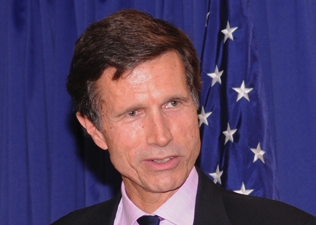
U.S. Assistant Secretary of State for South and Central Asia Robert Blake hailed transportation agreement between Afghanistan and its two Central Asian neighbors.
“Kyrgyzstan, Tajikistan, and Afghanistan have just formalized their own Cross-Border Transport Agreement. We see these types of developing trade relationships as win-win situations, and we are working hard to support them,” Blake told U.S. lawmakers during a Congressional hearing at the House Subcommittee on the Middle East and South Asia on Wednesday.
According to the Asian Development Bank, the Cross-Border Transport Agreement (CBTA), signed by Kyrgyzstan and Tajikistan in 2010 under the framework of the Central Asia Regional Economic Cooperation (CAREC) program, will ease the movement of goods, vehicles, and people across the designated borders due to streamlined customs inspections. Last fall, Kyrgyzstan and Tajikistan welcomed Afghanistan as a third member of the CBTA.
Blake told the hearing that such cross border agreements are part of the New Silk Road initiative aimed at expanding economic opportunity and stability for the entire region.
“Secretary Clinton outlined a vision of economic cooperation, trade liberalization, and increased trade flow during her visit to Chennai last summer, referring to it as a “New Silk Road.” The New Silk Road approach envisions a network of economic and transit connections running throughout South and Central Asia, with Afghanistan at its heart,” he said.
“The idea is a simple one: by maximizing the use of transportation and energy infrastructure and actively promoting cross-border collaboration and trade, this region can once again become a bustling hub for global commerce,” Blake said. “The United States will play a facilitating role, however real progress must come through improved cooperation among neighbors in the region. Leaders from the region met last fall in Istanbul to discuss concrete ways to improve their cooperation and again in Dushanbe in March. We are starting to see regional ownership and some momentum in this effort and our budget request includes resources to facilitate regional cooperation in support of Afghanistan‘s transition and integration into the wider region.”
