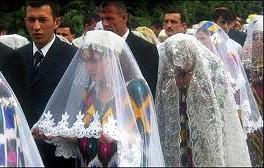
DUSHANBE, December 27, 2012, Asia-Plus — An article “Child Marriage – A Threat to Health” posted on the website of the World Health Organization (WHO) Regional Office for Europe notes that data from 2000–2009 suggest that 19% of women aged 20–24 years throughout the WHO European Region were in a union or marriage before the age of 18, with Moldova, Georgia, Turkey and Tajikistan accounting for the highest rates.
Child marriage disproportionately affects girls and has an impact on their mental and physical health for the rest of their lives. Not only are they denied the right to choose their own partner, they are marginalized and subject to various religious, societal, political and cultural practices that fail to honor their basic human rights.
The physical health of the female spouse in a child marriage faces several threats. These young girls are often the victims of domestic violence, and they lack the means to advocate for themselves. Additionally, child brides often live with their husband’s extended family, which may also be a source of violent abuse, in crowded conditions.
According to the article, their psychological well-being and empowerment also suffer, as young girls in child marriages are denied an appropriate childhood and adolescence, and are subject to an increased incidence of psychological abuse as well as domestic violence; a curbing of personal liberty; an incomplete education; and a lack of employment and career prospects – all of which contribute to the cyclical nature of poverty, gender inequality and child marriage.
Complications from pregnancy and childbearing are the leading causes of death among girls aged 15–19 years. Often, those in child marriages do not have access to adequate health and contraceptive services, owing to geographic location or the oppressive conditions of their lifestyle.
WHO and the United Nations Population Fund (UNFPA) address the effects of child marriage.
An article “Tajikistan: Child Marriage” posted on the UNFPA website notes that child or early marriage is the union of two persons, at least one of whom is under 18 years of age. By virtue of being children, child spouses are considered to be incapable of giving free and full consent, meaning that child marriages should be considered a violation of human rights and the rights of the child. In Tajikistan, child marriages occur in some regions of the country, and are primarily linked to social and religious factors, as well as poverty, the article noted.
We will recall that Tajik President Emomali Rahmon signed a law amending the country”s Family Code to raise the legal age for women to marry from 17 to 18 years on July 23, 2010. The amendments took effect on January 1, 2011 and parents who attempt to have their daughters married before the age of 18 will be prosecuted. Many Tajik experts say poverty is the main reason parents seek to have their daughters marry at a young age. The second factor mentioned by Tajik experts is that hundreds of thousands of Tajik men leave the country in search of work, mainly for Russia. Many of them postpone getting married or leave their wives and marry a second woman abroad. That leaves fewer men looking for Tajik wives.