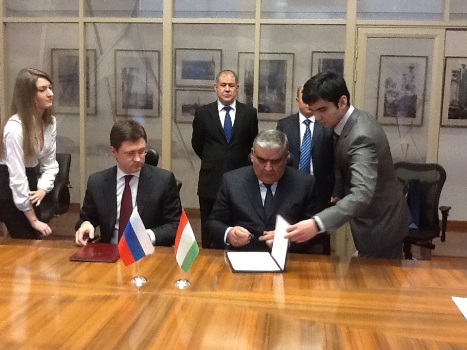
DUSHANBE, February 7, 2013, Asia-Plus – Tajikistan and Russia have reportedly signed an agreement on duty-free Russian oil product deliveries to Tajikistan
Muhammad Egamzod, a spokesman for the Tajik Embassy in Moscow, says Tajik Minister of Energy and Industries Gul Sherali and Russian Minister of Energy Alexander Novak inked the document in Moscow on February 6.
Under this agreement, the sides consider and endorse the indicative fuel balance for the next calendar before October 1 of each year. Fuels delivered in addition to the indicative fuel balance will be liable to export duty.
Russian oil products delivered to Tajikistan in the volumes not exceeding those agreed on indicative balance are not subject to re-export to the third countries. This ban also applies to Russian oil products delivered to Tajikistan from other member nations of the Customs Union.
Under the indicative fuel balance endorsed for 2013, Russia will deliver one million tons of oil products with 50 percent of them being gasoline, free of duty to Tajikistan this year.
We will recall that Tajikistan was exempted from paying Russian tariffs on oil and gas exports from 1995-2010 and Russia cancelled Tajikistan’s tax exemption on May 1, 2010 that resulted in gasoline prices rising in the country. A sudden spike was reported in May 2011, when export duty for Russian gasoline rose 44 percent as compared with April.
On October 5 last year, the Ministry of Energy and Industries of Tajikistan and the Ministry of Energy of the Russian Federation signed a memorandum on the conditions for the delivery of Russian oil products to Tajikistan.
Meanwhile, Hamdam Taghoymurodov, the head of the Antimonopoly Agency under the Government of Tajikistan, told journalists in Dushanbe on January 24 that there ought not to expect gasoline prices to fall sharply after signing of a government-to-government agreement between Tajikistan and Russia on duty-free delivery of Russian oil products to Tajikistan.
According to him, other reasons not allowing cutting fuel prices may occur by that time. “One of such reasons is transit tariffs imposed by Uzbekistan on fuel deliveries through its territory,” Taghoymurodov noted.
In addition to this, the Ministry of Finance has offered the Government to double the rate of excise tax on oil products.
In a report released in Dushanbe, Minister of Finance, Safarali Najmiddinov, noted on January 25 that they offered to raise the rate of excise tax on oil products from 40 to 90 euros per one ton.