
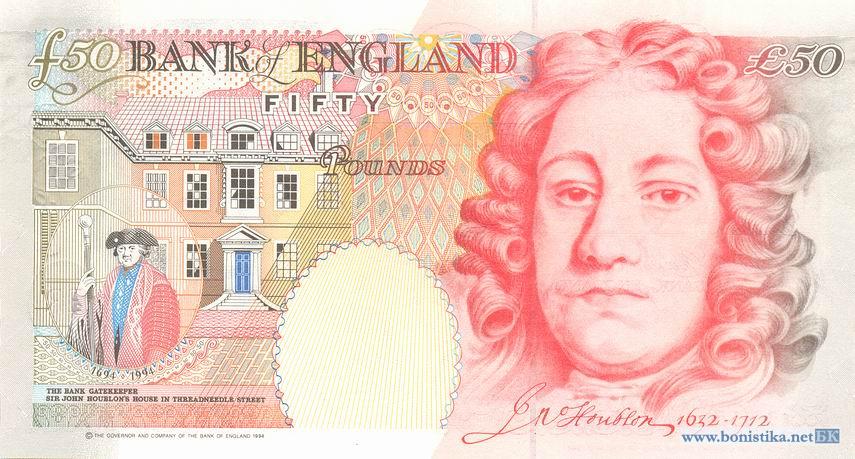
DUSHANBE, January 28, 2014, Asia-Plus – the press center of the National bank of Tajikistan reports that the Bank of England has announced that £50 banknotes featuring the first governor of the bank of England, Sir John Houblon will be withdrawn from circulation by April 30, 2014.
From May onwards retailers are unlikely to accept the Houblon notes as payment, but most banks and building societies will still allow customers to deposit them into their accounts. However, agreeing to exchange the notes after 30 April will be at the discretion of individual institutions, according to Tajik central bank.
Besides, Barclays, NatWest, Royal Bank of Scotland (RBS), Ulster Bank and the Post Office have reportedly agreed to exchange the older-style £50 notes for both customers and non-customers up to the value of £200 until 30 October, 2014.
The Houblon note, marking the contribution of the first governor of the Bank, was introduced in 1994.
The new £50 banknote featuring Matthew Boulton and James Watt entered into circulation in November 2011. The pair feature on the new note partly because they were instrumental in manufacturing coins that were difficult to counterfeit. The banknote reportedly includes a number of new security features.
The Guardian
says around 224 million £50 notes worth £11.2 billion are in circulation, of which the Bank of England estimates 63 million with a total value of £3.2 billion are banknotes bearing the portrait of Sir John Houblon. The Houblon notes are to be withdrawn from circulation in 15 weeks” time,
The Guardian
reported on January 16.
The withdrawal of the Houblon note is reportedly part of the Bank”s regular review of notes to make them more secure and combat fraud. The new version of the £50 banknote has a thread woven into the paper, rather than printed on it. There are images on the thread of a £ symbol and the number 50 which move up and down when the banknote is tilted from side to side. When the note is tilted up and down, the images move from side to side and the symbols switch. This is the first time that two portraits will appear together on the reverse of a Bank of England banknote.
