
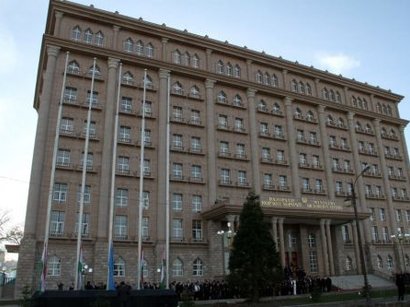
DUSHANBE, July 15, 2014, Asia-Plus – Tajik Foreign Minister Sirojiddin Aslov today left for Bishkek, Kyrgyzstan to attend the 8th meeting of the Central Asia plus Japan Dialogue Foreign Ministers that will take place there on July 16.
According to the Tajik MFA information department, delegations of Japan, Kazakhstan, Kyrgyzstan, Tajikistan, Turkmenistan, and Uzbekistan will participate in the meeting to discuss issues related to strengthening peace, stability, and democracy in the region; promoting social development and expanding regional cooperation.
The Central Asia plus Japan Dialogue is a political initiative between Japan and the Central Asian nations of Kazakhstan, Kyrgyzstan, Tajikistan, and Uzbekistan, with the goal to create “a new framework for cooperation, thereby elevating relations between Japan and Central Asia to a new level.” The dialogue, according to the Japanese Foreign Ministry, is also meant to serve as a forum to promote inter-regional cooperation. Turkmenistan, maintaining its policy of neutrality, participates only as an observer.
The Dialogue was formally declared on August 28, 2004 in Astana, Kazakhstan at a meeting of foreign ministers from the four participating Central Asian governments and Japan. A joint statement was issued which outlined the parties” views on four areas: fundamental principles and values; expansion of Japanese-Central Asian relations; intra-regional cooperation within Central Asia; and cooperation in the international arena.
The statement also declared the dialogue”s main objectives: the strengthening of peace, stability, and democracy in the Central Asian region; the strengthening of the region’s economic foundations, the promotion of reform and the social development of the region, including the correction of intra-regional disparities; the strengthening of intra-regional cooperation by the Central Asian countries; the maintenance and development of good relations between Central Asia and neighboring regions as well as with the international community; and cooperation between Japan and Central Asia with respect to both regional issues and issues having international dimensions. The joint statement also outlined several areas of potential Japanese-Central Asian cooperation.
