
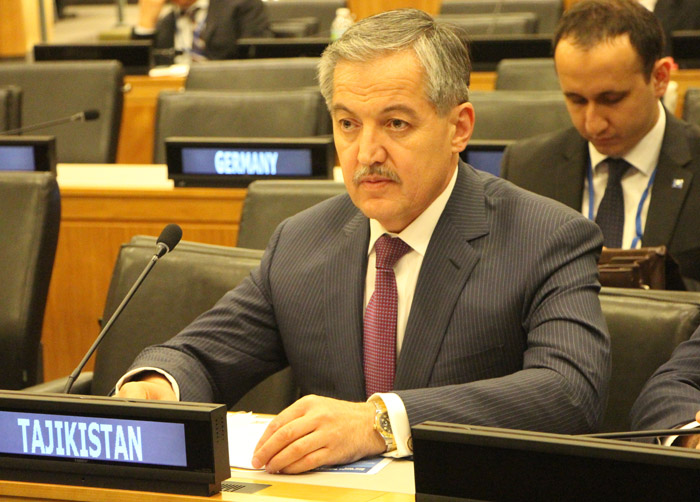
DUSHANBE, September 26, 2014, Asia-Plus – On Friday September 26, Tajik Foreign Minister Sirojiddin Aslov delivered a statement at the 13th Annual Ministerial Meeting of the Landlocked Developing Countries (LLDCs) that took place in New York on the sidelines of the 69th session of the UN General Assembly, according to the Tajik MFA information department.
Tajik minister, in particular, noted that socioeconomic development of the Central Asian region was impossible without expansion of efficient transit systems, development of the transportation infrastructure, increase in trade turnover, rise in competitiveness, promotion of inclusive economic growth and sustainable development for the purpose of reducing poverty.
He further noted that achievement of those goals was impossible without close regional cooperation and large-scale investment both in bilateral and multilateral format.
Currently, 31 countries belong to the Group of landlocked developing countries (LLDCs): 15 are located in Africa, 12 in Asia, 2 in Latin America and 2 in Central and Eastern Europe. Lack of territorial access to the sea, remoteness and isolation from world markets and high transit costs continue to impose serious constraints on the overall socio-economic development of landlocked developing countries. Their sea borne trade unavoidably depends on transit through other countries. Additional border crossings and long distance from the market substantially increase the total expenses for the transport services.
The economic performance of landlocked developing countries reflects the direct and indirect impact of geographical situation on key-economic variables. Landlocked developing countries are generally among the poorest of the developing countries, with the weakest growth rates, and are typically heavily dependent on a very limited number of commodities for their export earnings. Moreover, of 31 landlocked developing countries 16 are classified as least developed.
