
DUSHANBE, February 3, 2016, Asia-Plus — Tajikistan and Turkmenistan still failed to reach an agreement on an Afghan segment of a regional rail link that will connect Turkmenistan, Afghanistan and Tajikistan (TAT regional rail line).
“Unfortunately, we have not yet signed the program document on this railway because we still have some unsolved issues with Turkmenistan,” Tajik Minister of Transport Sherali Ganjalzoda told reporters in Dushanbe on February 3.
“We have reached an agreement with Afghanistan on all issues and it just remains to coordinate some aspects with Turkmenistan,” the minister said.
According to him, the Tajik government is currently studying the document that should be signed by the sides
“After signing of this document there will be an opportunity to prepare an agreement on implementation of the project that will be signed by the heads of the three countries,” Ganjalzoda added.
We will recall that a memorandum of understanding (MoU) for construction of the rail link connecting the three countries was signed during a trilateral meeting of the presidents of Tajikistan, Turkmenistan and Afghanistan that took place in the Turkmen capital Ashgabat on March 20, 2013.
The 400-kilometer railroad is expected to connect the Afghan town of Akina-Andkhoy to Atamurat-Ymamnazar in Turkmenistan and Panj in Tajikistan.
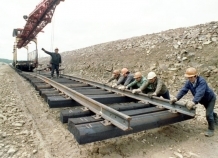
The presidents of Afghanistan, Tajikistan, and Turkmenistan officially inaugurated the construction of the railway connecting the three nations on June 5, 2013. Presidents Hamid Karzai, Emomali Rahmon and Gurbanguly Berdymukhammedov participated in the ceremony that took place in Turkmenistan”s northeastern province of Lebap. They buried a time capsule with a message to future generations under the first section of the railway line near the town of Atamyrat.
Meanwhile, optimism about the project dimmed in January 2014. The then head of Tajik Railways Amonullo Hukumatullo announced at a news conference in Dushanbe on January 29, 2014 that Tajikistan and Afghanistan had themselves decided on the route for the Afghan section of the rail. He said the new Afghan section was slightly over 200 kilometers, but shorter than the initial plan and thus would save Tajikistan in transit fees.
The announcement apparently caught Ashgabat by surprise because on January 30, the Turkmen Foreign Ministry protested that Hukumatullo’s declaration was “tendentious and absolutely unacceptable” and “counterproductive.”
The TAT railway will be a part of a broader regional transportation initiative that will open a new transit corridor between Central Asia and world markets through Indian Ocean ports, a route less than half as long as Central Asian existing railway export options through Russia to the Baltic Sea coast. The TAT railway has a regional strategic implication, as it will enable Turkmenistan, Afghanistan and Tajikistan to have a railway line bypassing Uzbekistan. While the TAT railroad will diversify the transport routes of Tajikistan and Afghanistan, the greatest beneficiary will be Tajikistan, as the TAT rail line will allow it to overcome its current transportation deadlock and dependency on Uzbek railroads for transit. In the past Uzbekistan has frequently blocked its railway lines linking to Tajikistan, using Tajik transit dependency as leverage for political pressure.
