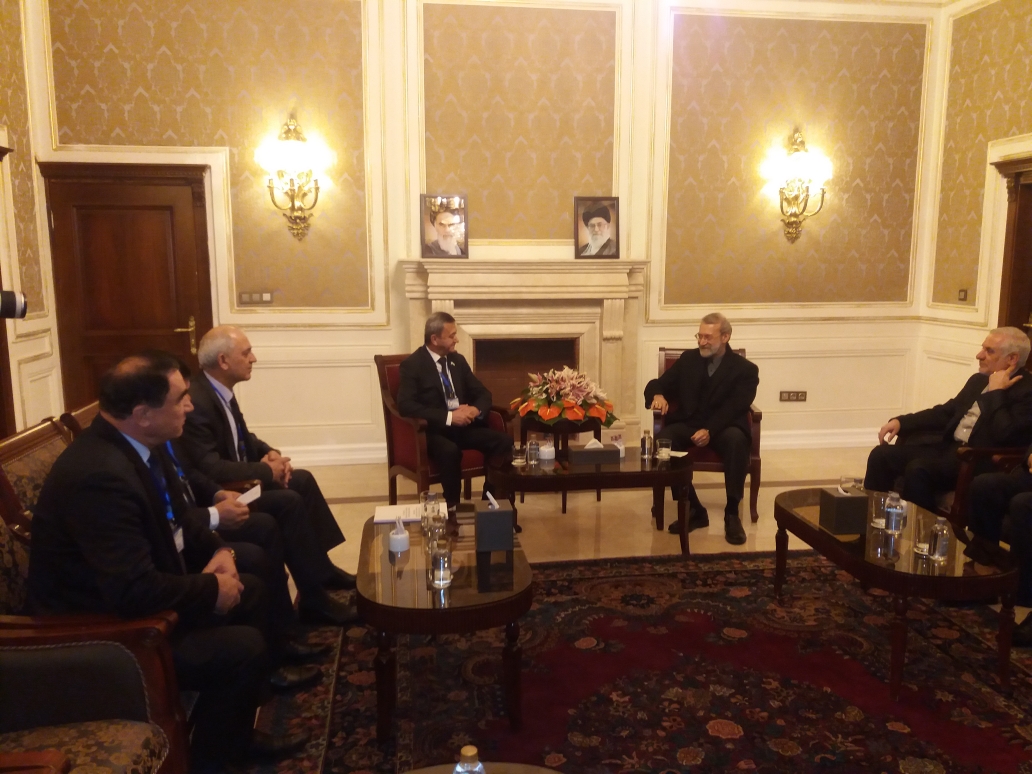
On Monday January 15, Abdujabbor Azizi, Vice-Speaker of the Majlisi Namoyandagon (Tajikistan’s lower chamber of parliament), met in Tehran with Ali Larijani, Speaker of Iran’s Parliament (Majlis).
In the course of the talks, Azizi said that Tajikistan attaches significance to expansion of bilateral cooperation with the Islamic Republic of Iran, Muhammadato Sultonov, a spokesman for the Majlisi Namoyandagon, told Asia-Plus in an interview.
According to him, Tajik vice parliament speaker noted that parliamentarians of both countries should study experience of each other and exchange visits.
Iranian parliament speaker, for his part, said that Tajik parliamentarians’ visit will provide new opportunities for expansion of cooperation between the two countries in the legislation sphere, Sultonov said.
Meanwhile, Iran’s IRNA reports that Ali Larijani said on Monday that it sounds necessary to revise customs tariffs between Iran and Tajikistan to help broaden economic cooperation and encourage investment opportunities.
Both neighbors should pay heed to issues which may put their securities at risk, the Iranian parliament speaker was quoted as saying.
Issues such as terrorism and drug trafficking can create problems for both countries and this requires close cooperation between the two sides, he said, according to IRNA.
Language and cultural commonalities will persuade businessmen of both sides to engage in joint investment, Larijani added.
To attain the goal it sounds necessary to revise customs tariffs as well as easing trade exchange between the two sides, the Iranian parliament speaker added.
He expressed the hope to witness further expansion of cooperation between the two countries.
Tajik vice parliament speaker, for his part, expressed the hope to witness further expansion of relations and cooperation between the two nations, IRNA said.
Tajik parliamentary delegation has arrived in Tehran for participation in the 13th session of the Parliamentary Union of the OIC Member States (PUIC) that kicked off on January 16.
Tajikistan and Iran have traditionally close relations, sharing many similar cultural, religious and ethnic identifiers and Iran has been a major sponsor of essential hydropower infrastructure in Tajikistan, but Iran has angered Tajikistan by welcoming IRPT leader Muhiddin Kabiri, who is wanted by police in Tajikistan to face various terrorism charges.
Recall, Iran invited IRPT leader Muhiddin Kabiri to attend the International Islamic Unity Conference that took place in Tehran on December 27-29, 2015.
Tajikistan’s MFA said in a statement on December 29, 2015 that it was “greatly concerned” that “the head of the extremist and terrorist former IRPT, Muhiddin Kabiri, who faces charges of attempting to overthrow the government … has been invited to the conference.”
In April 2016, Tajikistan’s customs service introduced restrictions on the import of food products from Iran. Dry leaf tea, poultry and other goods were ruled unacceptable for their allegedly poor quality. In July 2016, the Tajik office of Iran’s Khomeini Imdod Committee, an international development fund, closed. In early July this year, the Iranian trade and culture center in the Tajik northern city of Khujand, which was particularly appreciated for its library services and fast internet, closed its doors. The shuttering reportedly came at the request of the Tajik authorities.
In August 2017, Tajik authorities have accused Iran of backing high-profile killings in Tajikistan during the Tajik civil war in the 1990s. In a documentary broadcast on Tajik national television on August 8, the Interior Ministry of Tajikistan claimed that Iran was allegedly interested in unleashing civil war in Tajikistan, and it allegedly provided assistance to the Islamic Revival Party of Tajikistan (IRPT) and trained its militants in Iranian territory. The documentary also accused Iran of involvement in the murder of several Tajik social and political figures as well as 20 Russian military officers in the country during the 1990s Tajik civil war. The documentary further claimed that at the time, Iran had organized a plot to “eliminate Tajik scientists and intellectuals.
Iran’s Embassy in Dushanbe on August 9, 2017 released a statement, in which it dismisses “unfounded claims made in the documentary.” The statement posted on the Embassy’s website, in particular, described such claims as 'regrettable' saying there is no doubt that the documentary’s producers will not be able to mar cultural bonds and historic friendship between the two nations of Iran and Tajikistan.
It added that the noble nation of Tajikistan will never forget that Iran as one of the main founders and guarantors of Tajikistan’s peace and host of talks between the country's conflicting sides, has played a constructive role in ending Tajikistan's civil wars in 1990.