Senior representatives of Tajik and Chinese ruling parties – the People Democratic Party of Tajikistan (PDPT) and the Communist Party of China (CPC) – have met in Dushanbe to discuss cooperation.
“The first deputy leader of the PDPT, Saidmurod Fattohzoda, today received a delegation of the Communist Party of China, led by Len Zhun (phonetically spelled),” Usmon Soleh, the head of the PDPT public relations department, told Asia-Plus Monday afternoon.
In the course of the talks, the two sides reportedly discussed issues related to cooperation between the two political parties and the progress of implementation of the protocol of cooperation that was signed between the PDPT and the CPC in 2011.
While in Dushanbe, the CPCP delegation will also hold meetings with PDPT activists and senior representatives of the Center for Strategic Studies under the President of Tajikistan, Soleh added.
Founded in 1994, the People’s Democratic Party is the largest political party in Tajikistan, boasting more than 480,000 registered members. President Emomali Rahmon is chairman of the party. According to the PDP Central Committee, youth make 40 percent of the party members.
At the legislative elections, February 27 and March 13, 2005, the party won 74% of the popular vote and 52 out of 63 seats (74 percent of the popular vote). This was an increase from the 2000 elections, in which they won 64.9% of the vote and 38 seats. At the legislative elections, February 28, 2010, the party won 71.69% of the popular vote and 45 out of 63 seats.
At the last legislative election, March 1, 2015, the PDP won 65.4 percent of the vote and 51 out of 63 seats.
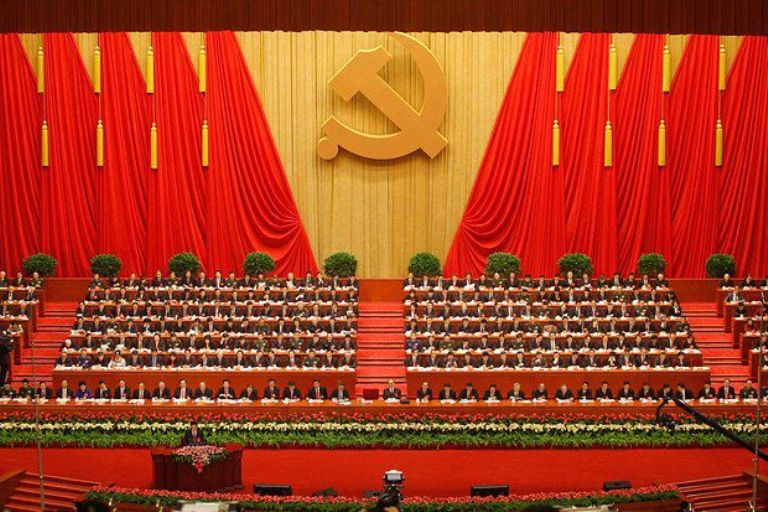
The Communist Party of China (CPC) is the founding and ruling political party of the People’s Republic of China (PRC). The CPC is the sole governing party of China, although it coexists alongside 8 other legal parties that make up the United Front. It was founded in 1921, chiefly by Chen Duxiu and Li Dazhao. The party grew quickly, and by 1949 the CPC had driven the Kuomintang (KMT) from mainland in a 10-year civil war, thus leading to the establishment of the People’s Republic of China. The CPC currently has nearly 90 million members, making it the second largest political party in the world after India's Bharatiya Janata Party.
Since the decline and fall of communism in Eastern Europe, the CPC has begun establishing party-to-party relations with non-communist parties. The CPC continues to have relations with non-ruling communist and workers’ parties and attends international communist conferences, most notably the International Meeting of Communist and Workers’ Parties.