

Central Asia is prone to earthquakes, landslides, floods, mudflows, droughts, avalanches, and extreme temperatures. These natural disasters lead, on average, to an astounding $10 billion in estimated economic losses every year, Ms. Lilia Burunciuc, the Regional Director for the Central Asia Region at the World Bank, notes in her blog.
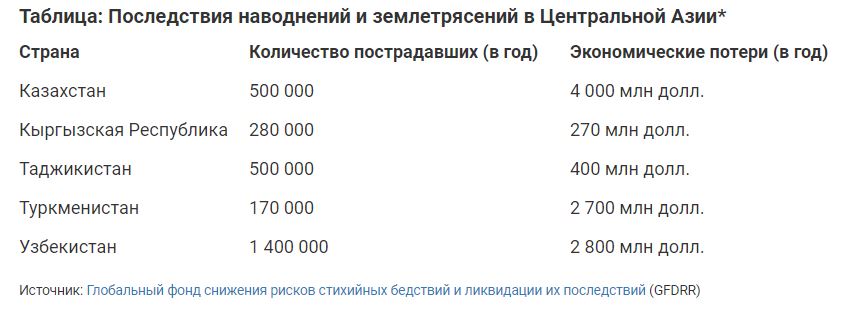
Natural disasters reportedly affect close to 3 million Central Asians annually almost half of whom live in Uzbekistan. And these are more than just statistics; the reality is that people die, lose loved ones, sustain serious injuries, and suffer devastating economic losses.
In Tajikistan, natural disasters reportedly affect 500,000 people annually and natural disasters cost Tajikistan 400 million U.S. dollars.
Over the years, the governments in each country have been developing strategies to respond more quickly to save more lives, help people recover sooner, and put better prevention plans in place. Tajikistan an Kyrgyzstan, for example, have interagency disaster preparedness and response systems supported by international partners. The World Bank has been aiding these and other prevention and preparedness disaster risk management efforts through a number of projects, such as Enhancing Resilience in Kyrgyzstan and Strengthening Critical Infrastructure against Natural Hazards in Tajikistan.
Acting at the country level is important, but as we know, disasters know no borders.
Take the Syr Darya river that weaves through four countries in the region: Kazakhstan, the Kyrgyz Republic, Tajikistan, and Uzbekistan. The river is critical to Central Asia, including for energy generation and irrigation, yet it also poses a major cross-border risk to thousands of people living in the river basin. A combination of human-made and natural forces render this area particularly vulnerable. Increased water releases from the Toktogul reservoir in the Kyrgyz Republic and frequent ice jams that form along the course of the river, as well as rainfall and snowmelt, have in the past led to flooding in places like Jizzakh and Navoi provinces in Uzbekistan and Kyzylorda city in Kazakhstan.
The countries in the region have been cooperating successfully to improve the accuracy and timeliness of hydromet services supported by a World Bank project. And a regional Almaty-based Center for Emergency Situations and Disaster Risk Reduction has been focusing on a disaster risk reduction agenda for the region as a whole. Nevertheless, much more needs to be done at the regional level.
One of the newer regional initiatives is the establishment of a Regional Scientific and Technical Council, which acts as a public expert advisory body to the emergency agencies in Central Asia. The Council is working on a regional disaster risk assessment to help the Central Asian governments obtain reliable risk data and better design their risk and emergency plans.
Initiatives like these are possible thanks to funding from the European Union under the umbrella of the Strengthening Financial Resilience and Accelerating Risk Reduction in Central Asia Program, managed by the Global Facility on Disaster Reduction and Recovery and implemented by the World Bank.
Central Asia still needs stronger regional cooperation and increased information exchange. The COVID-19 pandemic has underlined the importance—and advanced the possibility of—closer collaboration. Identifying and understanding the risks of various hazards requires continued investment. We also need to find ways to mitigate or minimize these risks, including from pandemics, which are bound to recur.
As natural disasters continue to disrupt and threaten people’s lives and well-being in Central Asia and undermine regional economic gains, it is evident that disaster risk management must remain on the agenda for the safety and prosperity of this region.



