Since August 1, all mandatory government payments and utilities in Tajikistan are going to be paid only in cashless form. We decided to find out if the county’s banks are ready for it and what difficulties are the residents already facing.
At the end of 2018, the government of Tajikistan adopted a resolution, which obligated all the enterprises and institutions, that provide paid services, to give their customers an opportunity to make cashless payment from April 1, 2019.
At the end of 2022, the President of Tajikistan, during his speech to the parliament, instructed “from July 1, 2023 to fully establish cashless payment of all taxes and state duties for the issuance of permits and licenses, fines, funds for compulsory state insurance, utilities and other types of public services."
At the end of June this year, a presidential decree instructed to carry out the following exclusively in non-cash payments from August 1:
– payment of taxes, state duties, licenses;
– compulsory insurance;
– utilities;
– bank settlements.
According to the National Bank, a sharp increase of non-cash payment for goods and services has been recorded in Tajikistan.
In the first half of the year, about 22 million non-cash transactions were made through payment cards and electronic wallets in retail establishments and service points of the country. And this is 52.1% more compared to the same period in 2022.
The total volume of payment for goods and services by non-cash transactions amounted to 5.5 billion somoni (about $ 505 million), which is 83.2% more than in the same period last year.
Sirijiddin Ikromi, the Head of “Amonatbank”, where the accounts of state structures are located, said at the press conference that most of the people already understand the advantages of cashless payment, they actively using banking cards and electronic wallets.
According to him, a sharp increase of in the number of users of mobile application “Amonat Mobile” indicated that people are massively switching to non-cash payment.
He stressed that from August 1, non-cash payment in the amount of 20-26 million somoni are made every day.
According to Ikromi, “Amonatbank” has prepared its infrastructure to accept cashless payment.
He noted that only tax collection points have increased 2.5 times since the beginning of this year – from 372 to 936 points today.
The points of acceptance of payments for utilities, according to him, are 826 units, and the users of “Amonat Mobile” application are 450 thousand people. He stressed that every week the number of users of this application increases to 10 thousand.
Also, according to the head of “Amonatbank”, the connection of state organizations and institutions to the Internet Banking service is successfully underway.
"Currently, more than 8 thousand organizations of the country are connected to this system. The system provides chief accountants and managers of enterprises and organizations with the opportunity to remotely (online) conduct payment orders and issue salaries," he stressed.
Ikromi added that in the coming days it is planned to purchase and install payment terminals for non-cash payments, which do not have an option for cash transactions.
Residents generally welcome the transition to cashless payment, but note that not all institutions have the necessary infrastructure for such operations. Meanwhile, queues are observed at popular payment points, including at the offices of the traffic police, the registry Office, the tax service, notary offices, passport offices, institutes and universities.
Our observations show that in most cases queues and failures are due to the fact that non-cash payments are mainly accepted by the card and wallet of “Amonatbank”, since the accounts of state institutions are mainly serviced by “Amonatbank”.
Another problem is that many institutions themselves do not understand the point of non-cash payments, and the infrastructure is not ready.
Other people say that they are not ready for the non-cash payment, as thit is something new for them.
Experts identify five main obstacles that hinder the development of non-cash payments in Tajikistan.
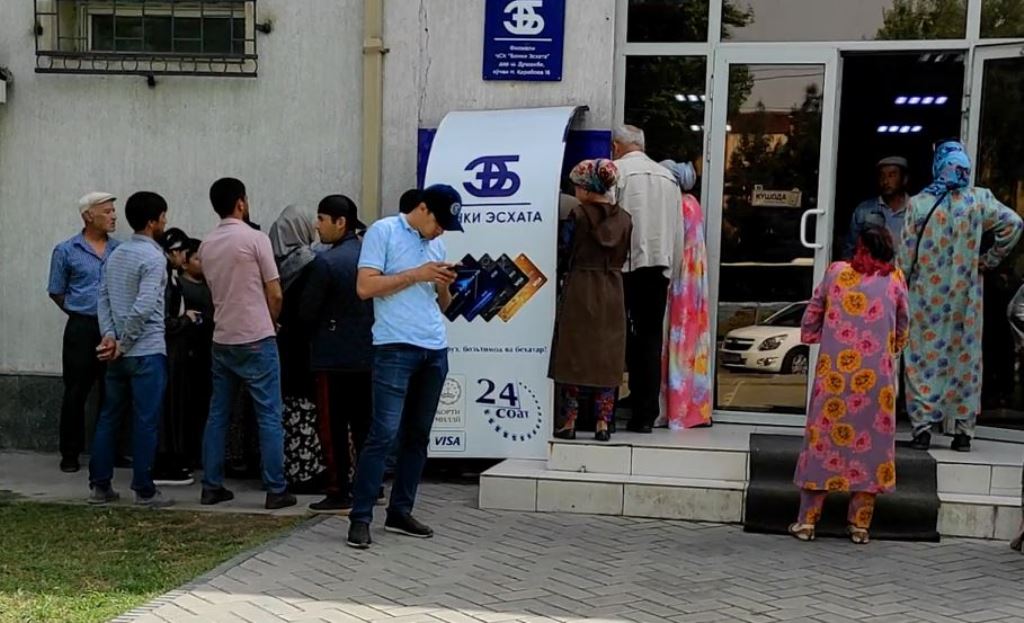
First of all, there is a lack of necessary infrastructure, especially in rural areas, and 70% of the country's population, according to official data, lives in villages.
In addition, many people do not trust the financial and banking system after the last crisis in the sector, which led to the liquidation of five banks. Therefore, many cardholders, after accruing salaries and pensions, immediately line up at bank machines to cash out their money.
Another reason for the underdevelopment of non-cash payments in the country is considered to be low financial literacy of the population.
Bank employees claim that many perceive bank cards exclusively as an element of cash transfer and do not even suspect that it can be used to pay for goods and services, transfer money, and perform other operations.
Another barrier is expensive and low-quality Internet.
In the global ranking of Worldwide mobile data pricing by the end of 2022, Tajikistan ranks 131st in the world with an average price of $1.94 per 1GB.
The fifth and perhaps the main reason for our non-cash insolvency is the unwillingness of merchants to work transparently due to the high tax burden.
Many of them claim that they cannot afford to completely switch to accepting cashless payments, as this will show the tax authorities all the income. And it is very difficult to earn with the current tax burden with full payment of all taxes.




