
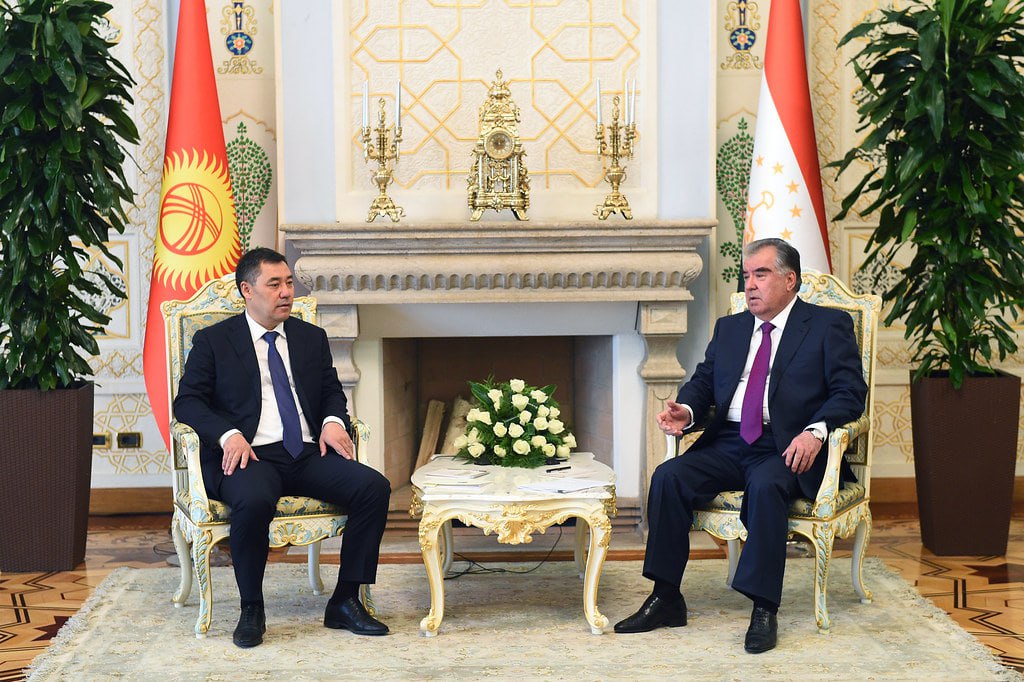
President of Kyrgyzstan Sadyr Japarov shared that a 10-hour meeting with Tajik President Emomali Rahmon in Dushanbe paved the way for resolving the border dispute between the two countries. He also emphasized the crucial role of Uzbek President Shavkat Mirziyoyev in signing the trilateral border agreement in Khujand.
In the second part of the documentary President, released on January 6, Japarov revealed key details of the border negotiations and the signing of the agreement between Tajikistan, Uzbekistan, and Kyrgyzstan. He recalled the border incidents with Tajikistan, calling them "days of historic testing and sorrow" and stressed that such events should never be repeated.
Japarov recalled the armed conflict between Kyrgyzstan and Tajikistan in April 2021 in Batken, which resulted in human casualties. He emphasized the destruction of homes and the suffering of residents in border villages, noting that he visited Batken multiple times to witness the challenges of resettling people and rebuilding their homes.
"We spent 10 hours in one room, having heated discussions"
Japarov explained that in June 2021, following the armed clashes, he traveled to Dushanbe to meet President Rahmon to establish a ceasefire and start negotiations. “We spent 10 hours in one room, having a heated discussion. In the end, we agreed that we would resolve the main issues peacefully, ensuring no more armed conflicts and transforming the border into a source of cooperation, not conflict,” said Japarov.
He noted that the main dispute involved areas totaling 166 kilometers, such as Vorukh, and mentioned working with Soviet-era maps and joint commissions.
While the documentary provides Japarov's perspective, it does not include direct statements from Rahmon or delve into the sensitive details of the negotiations, such as the terms proposed by both sides.
Tajikistan's presidential press service confirmed the meeting in Dushanbe, stating that border security and preventing future conflicts were discussed. However, they did not mention the 10-hour duration of the talks.
The agreement and post-signing disputes
Japarov explained that the June 2021 meeting marked the beginning of the process that shifted the border issue from a conflict to a legal and diplomatic matter, culminating in the signing of the state border agreement.
After completing the demarcation process in December 2024, the final legal steps were taken:
· On March 13, 2025, the state border agreement was signed in Bishkek.
· On March 31, 2025, the documents were exchanged in Khujand.
Japarov emphasized that the land exchange was equitable, aimed at resolving contentious "chessboard" areas. He rejected claims of "losing too much land," stating that the agreement’s goal was not territorial loss but resolving the source of conflict.
The agreement involves the exchange of disputed land in the Isfara and Batken regions, each covering about 190–200 hectares. Tajikistan receives access to roads, the "Druzhba" market, and areas around Vorukh, while Kyrgyzstan gains agricultural land in Leylek, Lakkon, Min-Bulak, and near the "Golovnoy" water intake.
Border dispute history
Negotiations over the common border between Tajikistan and Kyrgyzstan began in 2002 but were irregular and infrequent until 2022. The unclear border often led to conflicts over water and land distribution, road access, and pastures, sometimes involving military personnel.
Major armed conflicts occurred on the Tajik-Kyrgyz border in April-May 2021 and September 2022, resulting in dozens of deaths and injuries. As a result, Kyrgyzstan closed the border starting in May 2021. The last major conflict accelerated the negotiation process.
Finally, on February 21, 2025, the two countries initialed the demarcation and delimitation documents in Bishkek, and the presidents signed them in March 2025.
"The resolution with Uzbekistan was key for Kyrgyzstan"
In the film, Japarov highlighted the role of Uzbekistan’s President Shavkat Mirziyoyev in resolving the regional border issues. “The border dispute involved not only Tajikistan but also Uzbekistan. The resolution with Uzbekistan, before reaching an agreement with Tajikistan, became an important and key experience for Kyrgyzstan,” Japarov said.
He praised Mirziyoyev’s leadership in striving for stability in Central Asia. The trilateral document, signed in Khujand on March 31, 2025, officially defined the borders between Tajikistan, Kyrgyzstan, and Uzbekistan.
Japarov concluded that after the agreement's signing and its legalization in the respective parliaments, border disputes were resolved, and any future disagreements should be settled through legal means, not with weapons.
