On the fourth anniversary of Russia's full-scale invasion of Ukraine, leaders of the G7 countries, including the United States, reaffirmed their unwavering support for Kyiv. In a joint statement issued on February 24, they pledged to continue assisting Ukraine in defending its territorial integrity, sovereignty, independence, and freedom.
Support for US peace initiatives
The G7 countries also expressed their backing for the peace process initiated by US President Biden and efforts to organize direct negotiations between Ukraine and Russia. The statement emphasized that Europe's leading role in this process, with involvement from other partners, is crucial. The leaders reiterated that a war-ending agreement could only be reached through direct dialogue between Ukraine and Russia. They also confirmed their willingness to provide Kyiv with reliable and effective security guarantees within the framework of the "Coalition of the Willing."
The G7 also welcomed efforts to support Ukraine through the winter months, as Russia intensifies its attacks on Ukraine's energy infrastructure.
First joint statement after Trump's return
This is the first joint statement by the G7 since Donald Trump's return to the White House, as noted by France, which is currently holding the G7 presidency, Deutsche Welle (DW) reported. The statement also highlights the countries' intention to cooperate on nuclear safety, including with the European Bank for Reconstruction and Development (EBRD) and Ukraine, to secure funding for protective infrastructure at the Chernobyl Nuclear Power Plant and prevent potential radiation risks for Europe.
Additionally, the G7 supported initiatives for the immediate, safe, and unconditional return of Ukrainian children.
The G7 consists of the United States, Canada, Italy, Japan, the United Kingdom, Germany, and France. France, Germany, and the United Kingdom also issued a separate statement reaffirming their commitment to achieving a just and lasting peace in Ukraine.
"Coalition of the Willing" supports Ukraine
More than 30 leaders from the "Coalition of the Willing" confirmed their "full and unwavering" support for Ukraine in its fight for sovereignty, territorial integrity, and the security of Europe. The meeting took place on February 24, partly online, at the initiative of UK Prime Minister Keir Starmer, French President Emmanuel Macron, and German Chancellor Friedrich Merz.
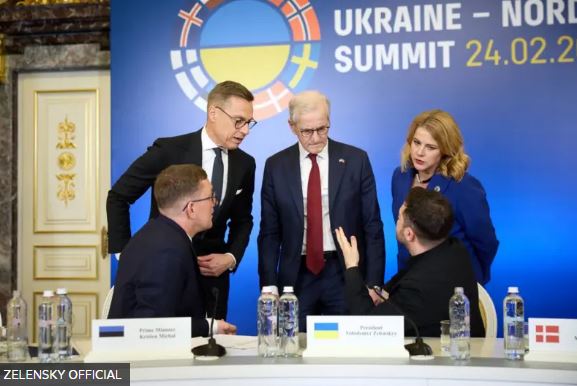
In Kyiv, for a face-to-face meeting with Ukrainian President Volodymyr Zelensky, European Commission President Ursula von der Leyen, European Council President Antonio Costa, and leaders from Northern Europe, the Baltics, and Croatia participated. According to the UK government website, over 30 heads of state and government attended the event.
The Northern European and Baltic countries pledged to provide Ukraine with military aid amounting to €12.5 billion this year. Ukrainian President Zelensky announced this after a meeting with these countries' leaders, as reported by the BBC News’ Russian Service. "We appreciate the willingness of Northern European and Baltic countries to continue supporting Ukraine: at least €12.5 billion in defense assistance this year and no less than €918 million for strengthening energy resilience," Zelensky wrote on social media after the summit in Kyiv.
European Commission President Ursula von der Leyen announced the EU's intention to provide Ukraine with a €90 billion loan despite Hungary's veto and to prepare the 20th sanctions package against Russia. Budapest has previously warned that it would block both the financial aid allocation and the new sanctions package unless the transit of oil via the Druzhba pipeline is resumed.
The Ukrainian side reported that the pipeline, which supplies Russian oil to Hungary and Slovakia, was damaged in Russian strikes on January 27.
UN General Assembly adopts resolution supporting peace in Ukraine
On February 24, the UN General Assembly adopted a resolution calling for an immediate, complete, and unconditional ceasefire between Russia and Ukraine, reports the BBC News’ Russian Service from New York. The resolution, titled "Support for a Sustainable Peace in Ukraine," was passed with the support of 107 countries. Twelve countries voted against, including Russia and Belarus, while 51, including the United States, abstained.
Countries voting against the resolution included Burkina Faso, Burundi, Cuba, North Korea, Eritrea, Iran, Mali, Nicaragua, Niger, and Sudan.