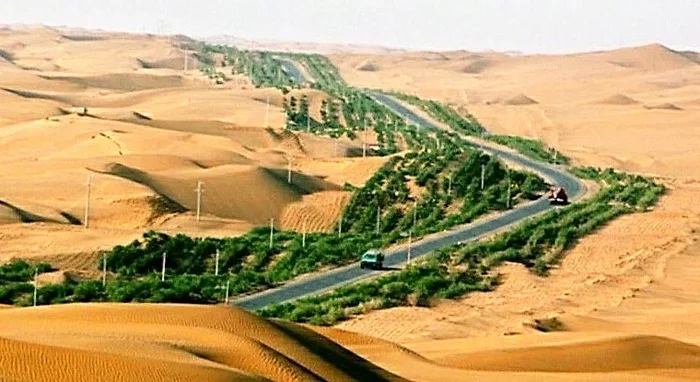
One of the driest regions on the planet, the Taklamakan Desert in the Xinjiang Uyghur Autonomous Region of China, under the influence of a targeted Chinese greening program, is gradually turning into a significant absorber of carbon dioxide from the atmosphere.
This is not about transforming the “sea of sand” into a continuous forest, but the perimeter of the desert—a strip of trees and shrubs planted here since the late 1970s—already absorbs more CO₂ from the atmosphere than it emits, and this effect has been confirmed by satellite measurements, writes Fergana.
The key to this transformation is the long-term Chinese project “Protective Forest Belt,” also known as China’s “Green Wall.” Started in 1978, it covers the northeast, north, and northwest of the country and has become the largest reforestation program in the world, aimed at combating desertification and sandstorms.
As part of this program, a continuous green belt around the Taklamakan is expected to be formed by the end of 2024, stretching about 3,000 kilometers. By the way, the total forest cover of China, according to official data from Beijing and specialized studies, has increased from about 10% in the mid-20th century to more than a quarter of the country’s area.
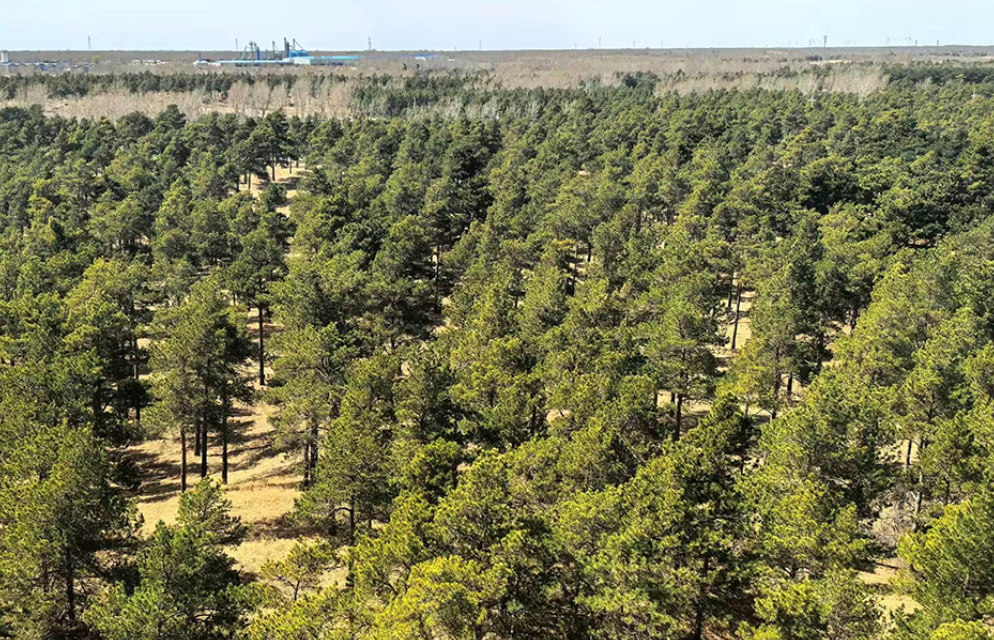
New work by an international group of researchers published in the journal Proceedings of the National Academy of Sciences shows that this artificially created plant belt around the desert has become a stable biospheric area—a zone where carbon absorption by plants and soils exceeds emissions, especially during the rainy season from July to September when precipitation around the Taklamakan reaches its peak.
Importantly, the main contribution to carbon absorption comes from relatively low trees and drought-resistant shrubs planted in strips to protect against sand and wind.
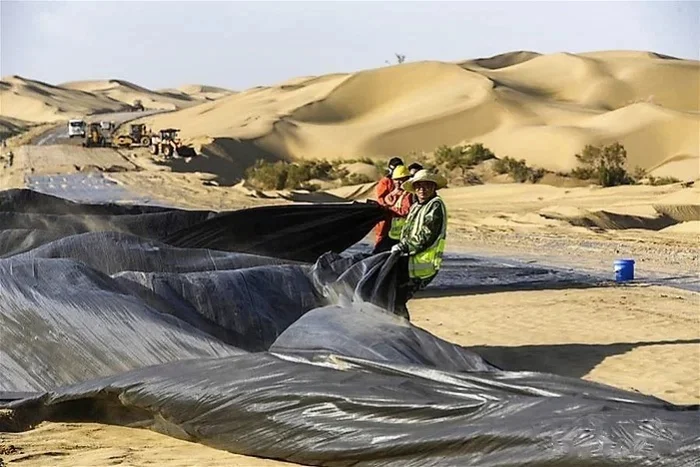
Decades ago, these plantings were primarily intended to protect pastures, fields, and infrastructure from advancing sands. It is now becoming clear that these same protective plantings also sequester carbon in biomass and soil, reduce wind erosion, and likely indirectly decrease dust emissions into the atmosphere.
Moreover, the success around the Taklamakan is largely attributed to geography: the desert is surrounded by mountain systems that provide runoff of melt and rainwater, creating the minimally necessary water supply for trees and shrubs. In other desert regions of the world, lacking such moisture sources, replicating this experience would be much more challenging and perhaps ecologically or economically questionable.
That is why the authors themselves and many experts emphasize the need for cautious transfer of China’s “green wall” to other contexts: before scaling such an approach, it is essential to carefully analyze water balance and soil salinization risks.
Against the backdrop of many traditional natural carbon sinks—such as certain forests or peatlands—partially losing their ability to sequester carbon and, in some places, turning into sources of CO₂ under warming and degradation, the example of the Taklamakan appears paradoxical and thus particularly illustrative.
It demonstrates that with long-term policy, serious investments, and careful selection of plant species, even the driest desert can become part of the climate solution equation—though not its main component. For Central Asia, suffering from desertification for decades, this experience is very important and indicative.