The government of Tajikistan has approved an action plan for 2026–2027 under the country’s Renewable Energy Sources Program for 2023–2027, aimed at expanding clean energy infrastructure and improving electricity access in remote regions.
The corresponding government’s resolution was adopted on April 28, 2026.
According to the document, the total funding for the plan will amount to 221.6 million somoni (approximately $25 million). Of this amount, 210.9 million somoni is expected to come from international donors, 9.1 million somoni from the private sector, and 1.55 million somoni from the state budget.
Solar and hydropower projects planned
A major part of the plan focuses on renewable energy infrastructure development.
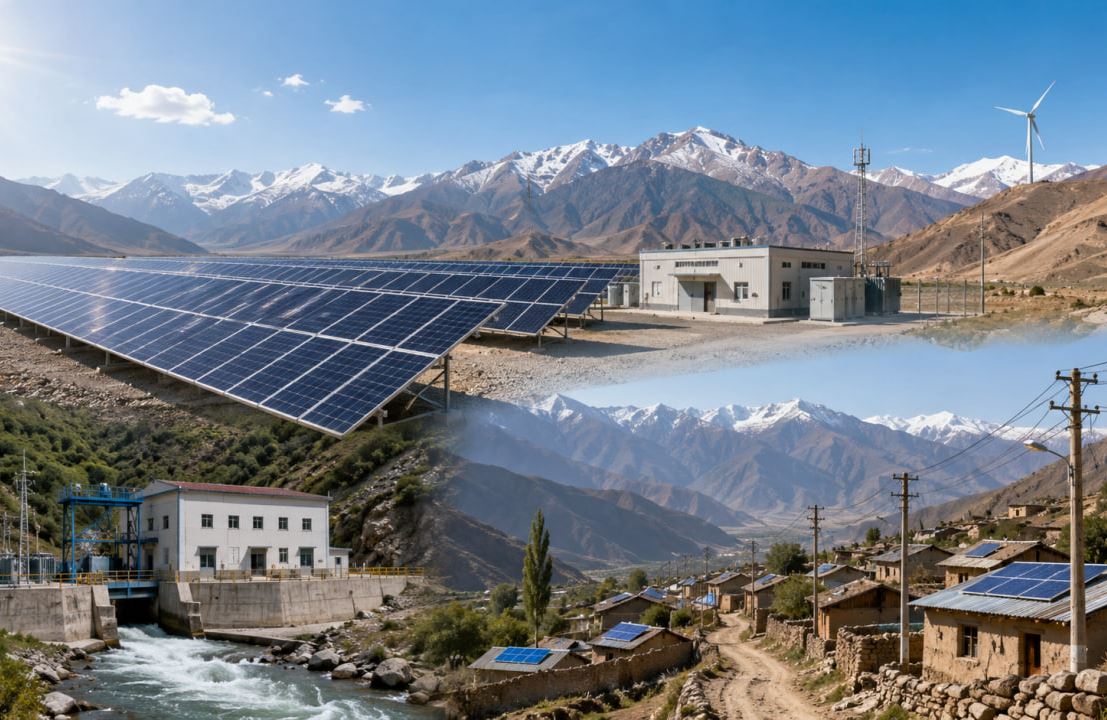
In 2026, Tajikistan plans to build two solar power plants in the Sughd Province and the Gorno-Badakhshan Autonomous Region (GBAO) with a combined capacity of 6 megawatts. Each plant will have a capacity of 3 MW and will include energy storage systems capable of storing 1 megawatt-hour of electricity.
Donor organizations are expected to provide 142.7 million somoni for these projects.
As part of the Village Electrification Project being implemented in GBAO, it is also planned to construct 11 small hydropower plants with a combined capacity of 0.275 MW, 19 small solar plants with a total capacity of 2.5 MW, and one small wind power station with a capacity of 0.2 MW.
The plan additionally includes the electrification of the villages of Shibdar and Rezga in Baljuvon district of Khatlon Province. Solar panels with a combined capacity of 0.065 MW are expected to provide electricity to 59 households and two secondary schools.
Solar expansion planned in Dushanbe
In 2027, the government plans to build solar power plants with a total capacity of 2.5 MW in Dushanbe.
The project is expected to be financed by the private sector, with planned investments totaling 9.1 million somoni. The implementing agencies include the Ministry of Energy and Water Resources, the Open Joint-Stock Company (OJSC) Electric Distribution Networks, and Somon Taxi Sayr LLC.
Authorities also plan to prepare a feasibility study in 2027 for a floating solar power plant at the Sarband Hydroelectric Power Plant reservoir. The proposed facility is expected to have a capacity of 10 MW.
Research and regulatory measures
The action plan also includes drafting rules for integrating electricity generated from renewable sources into the national power grid and regulating its distribution to consumers.
Research and educational initiatives under the plan include the training of specialists, the creation of a scientific laboratory dedicated to renewable energy, and studies on wind speed and solar radiation in northern Tajikistan to identify suitable locations for hybrid solar-wind stations.
Additional research will focus on the potential of rooftop solar systems, the use of small rivers and irrigation canals for hydropower generation in the context of climate change, and the study of local raw materials for biogas production.
The Ministry of Energy and Water Resources and the National Academy of Sciences are required to submit annual progress reports to the government by February 1 each year.
Renewable energy program revised
The Renewable Energy Sources Program for 2023–2027 was originally approved on March 1, 2023. It aims to promote efficient use of renewable energy, increase generating capacity, support scientific research, and improve electricity and heating supplies in remote mountainous areas.
The program also focuses on reducing greenhouse gas emissions, protecting the environment, developing tourism, and creating jobs in rural regions.
Under the latest amendments, total funding for the program has been revised to more than 1.225 billion somoni. Of this amount, 1.211 billion somoni is expected from development partners, 5.15 million somoni from the state budget, and 9.1 million somoni from private investors.
When the program was initially adopted, authorities estimated implementation costs at around 1.6 billion somoni (approximately $150 million), with most financing expected from international partners.