The "Shajareh Tayebe" school in the city of Mina, located in southern Iran, became a target on the first day of the U.S. and Israel's war against Iran. The attack resulted in the deaths of approximately 170 students and dozens of teachers. This horrific crime, initially ignored by the media and denied by the U.S. president and defense secretary, is now under increasing investigation, and the American role in it is becoming clearer.
Reports from media outlets and early admissions from U.S. officials confirm the strong likelihood that the United States, rather than Iran, is responsible for the killings. U.S. Congress is demanding that officials, including Defense Secretary Pete Hegseth, provide reports and the results of an investigation into the attack on the school. It appears that this tragedy could bring an end to the careers of not only the U.S. defense secretary but also the president.
"All my hopes were destroyed": the attack on the school
The attack on "Shajareh Tayebe," a school where children aged 7 to 12 studied, took place on February 28, when parents were bringing their children to school, and classrooms were full of students.
According to Iran's Ministry of Education, there were 264 students in the school that day. Sources report that 170 people were killed.
The school was hit by three separate strikes, according to eyewitness accounts and independent media investigations. Two Red Crescent doctors stated that after the first strike, the school principal led a group of students to a prayer room and called their parents to pick them up. Then the second strike hit, destroying the shelter. The third strike completely destroyed the remaining two-story building.
The roof of the school collapsed, and hundreds of people, most of whom were young girls, were buried under the rubble.
When news of the attack spread, concerned parents rushed to the school. Security forces tried to push them away from the destroyed building, fearing a new attack. However, parents who had lost their children, hearing their voices under the rubble, began to dig with their bare hands, despite the danger.
After the attack, Iranian media interviewed parents who were searching for their children amidst the fire and water. One parent shared, "The school called and said my daughter was alive. I rushed to pick her up, full of hope. But before I could get there, the second strike occurred, and all my hopes were shattered."
In a video that spread across social media and shocked the world, a man, finding blood-soaked books and notebooks among the ruins, yelled, "These are the books of the children who are now buried under these ruins. Do you see their blood? These are not soldiers, they were not going to war. It was a school, and they came here just to learn!"
The images published after the incident stunned the world: lifeless bodies in the arms of rescuers, books and notebooks stained with blood, tables and chairs amidst the ruins.
Nearby, a military base of the Islamic Revolutionary Guard Corps (IRGC) was also attacked.
Victim numbers vary
Ebrahim Tahiri, the prosecutor of Mina, reported that 165 people were killed and 96 were injured, most of whom were students. Other official Iranian sources report 168 dead, while some reports mention up to 180 victims. Among the dead, about 110 were children (66 boys and 54 girls), 26 female teachers, and 4 parents. The school principal was also killed.
On the same day as the school attack, the city's hospital was also attacked, worsening the condition of the wounded. Grieving families went to the hospitals to collect the bodies of their children, and the morgues of Mina were overflowing.
The rescue operation for the survivors concluded on March 1. On March 3, a memorial ceremony was held in the center of the city, attended by thousands of people. Published images showed that more than 100 graves had been dug for the victims of the school attack.
The first response from Mojtaba Khamenei
Mojtaba Khamenei, Iran’s new Supreme Leader, in his first address (read by an announcer), spoke of "revenge for the blood of martyrs" and said, "We will be more sensitive to the blood of our children."
He promised that the crime at the school would be thoroughly investigated.
What Iranian doctors, officials, and analysts say
Masoud Pizishkian, the President of Iran, called the attack on the school the work of the U.S. and Israel, stating that "this will never be erased from the historical memory of our people."
Abbas Araghchi, Iran's Foreign Minister, posted a photo of the destroyed school on social media and wrote, "This is a girls' school in southern Iran. On a clear day, when it was filled with students, it was bombed. Dozens of innocent children were killed… These crimes against the people of Iran will not go unanswered."
Esmail Baghaei, a spokesperson for the Iranian Ministry of Foreign Affairs, called the attack "an obvious crime" and condemned it, urging the UN Security Council to act according to its responsibilities under the Charter.
What Trump and U.S. officials say
U.S. officials' responses have been contradictory, simultaneously denying involvement, expressing doubt, and promising a lengthy investigation.
According to Reuters, General Dan Kane, Chairman of the Joint Chiefs of Staff, on March 2, openly showed a map of attacks, saying that their goal was to weaken Iran’s naval forces in the southern region. Importantly, the map also highlighted the attack on the city of Mina.
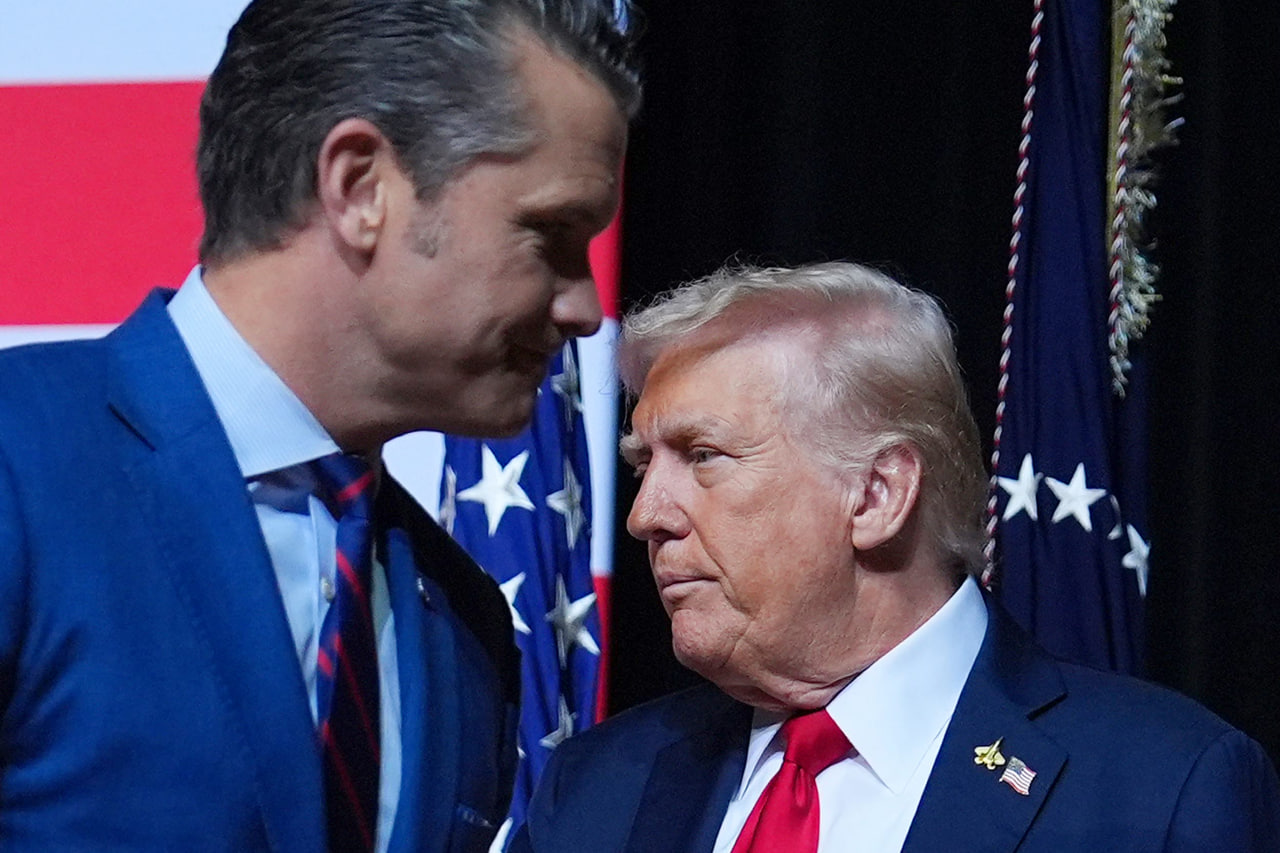
Pete Hegseth, U.S. Secretary of Defense, on March 4, refrained from providing specific answers, merely stating, "We are investigating the incident" (a map highlighting the attack on Mina was also presented at that meeting).
On March 7, Donald Trump, the U.S. President, without providing any documentation, blamed Iran, claiming that Iranian weapons were inaccurate and that they may have accidentally hit their own targets—a statement many experts considered absurd and false, typical of Trump.
U.S. senators pressure the Pentagon
On March 9, six key U.S. Senate Democrats, including influential figures like Brian Schatz, Patty Murray, Jack Reed, Mark Warner, Jeanne Shaheen, and Elizabeth Warren, issued a joint statement.
Their statement read, "The murder of schoolchildren under any circumstances is unacceptable and a horrific tragedy. Secretary Hegseth must conduct a thorough and comprehensive investigation to determine whether political decisions by the leadership were the cause of this tragedy."
The senators expressed particular concern about "rules of engagement," prompted by Hegseth’s previous statement, in which he harshly said that "operations against Iran should be conducted without restrictions, using all force and weaponry."
What independent media investigations revealed
Several independent investigations by outlets like Bellingcat, BBC Verify, CNN, NYT, CBC, NPR, and HRW have come to a unified conclusion: the attack on the school in Mina was carried out by the U.S.
The most crucial piece of evidence is that the Iranian news agency Mehr published a video of the attack, claiming the missile was American.
BBC Verify and other media outlets later conducted investigations and confirmed that the school building was hit by a "Tomahawk" missile. According to the researchers, the "Tomahawk" is a long-range naval weapon used exclusively by the U.S.
The Washington Post also reported, citing several weapon experts, that the missile used was a "Tomahawk," and The New York Times, on March 11, citing U.S. officials, reported that the attack was carried out by U.S. forces, citing outdated strike data.
Furthermore, Jeffrey Lewis, a well-known international security expert, rejected the theory that the missile was Iranian, stating that "the missile in this video does not match any known Iranian weapon," according to NBC News.
Reuters, on March 5, citing two U.S. officials involved in an internal investigation, wrote that "it is highly likely that the attack was carried out by U.S. forces."
CBC concluded that the target was a military complex but noted that "the school was attacked either as a result of a military error or serious intelligence failure."
Satellite data shows that until 2016, the site belonged to an IRGC military base but was later separated from it. The school had been functioning as a civilian educational institution for over 10 years, with no evidence of its military use.
International reactions
Following the deadly attack on the school, international organizations and prominent world leaders condemned the incident and called for an immediate investigation.
UNESCO described the attack as "a serious violation of international humanitarian law," emphasizing that schools must be absolutely safe under international law.
UN Secretary-General António Guterres also strongly condemned the attack.
Volker Turk, the UN High Commissioner for Human Rights, demanded "an immediate, impartial, and thorough investigation," noting that "responsibility for the investigation primarily lies with the forces that carried out the attack."
The UN Committee on the Rights of the Child, consisting of 18 independent experts, expressed deep concern over the incident, stating that "there is no justification for killing girls in a classroom!"
Human rights defenders, having reviewed 14 videos, photos, and 40 satellite images, concluded that the attack was carried out using "high-precision weapons." The organization stressed that this was not a "missile error" and called on the U.S. and Israel to acknowledge their guilt.
Activist and state reactions
Nobel Peace Prize laureate Malala Yousafzai, in a post on social media X, expressed deep sorrow: "This news broke my heart and made me feel anxious. Killing innocent civilians, especially children, is a violation of conscience, and I condemn it entirely."
Ravina Shamdasani, a spokesperson for the UN High Commissioner for Human Rights, called the attack "the most bloody and destructive event of recent times." She stressed the need for a thorough and independent investigation.
Russia and China also strongly condemned the attack in Mina, calling it "barbaric" and "inhuman" and blamed the U.S. and Israel.
Among European countries, only Italy clearly and directly condemned the attack. Prime Minister Giorgia Meloni, in the Senate, stated that she strongly condemned "the killing of the girls from Mina school" and demanded that "those responsible be swiftly found."
Other European countries have not yet issued specific statements on the tragedy and have not published any declarations. Other countries, including Central Asian states, have not made official statements regarding the incident.
Media reactions to the attack
The tragedy in Mina made headlines in major international media outlets like NYT, The Washington Post, BBC, CNN, Al Jazeera, Guardian, Reuters, CBC, and NPR. However, most of these outlets remained silent during the first week after the attack, drawing criticism for their lack of coverage.
For example, Marizyush Zawadzki, a Polish journalist for Gazeta Wyborcza, said that Western media largely ignored the incident during the first week and did not give it adequate attention.
Annie Shill, an expert at the Center for Civilian Protection in Conflicts (CIVIC), noted a prevalent trend in U.S. politics: "We have often seen Washington first deny its involvement in attacks, and then independent media and civil society investigations reveal the bitter truth." She warned that there is a risk that authorities will again try to cover up the truth.
Experts argue that, despite international media finally investigating the incident, the delayed response and excessive trust in official statements from U.S. authorities show that pressure from civil society is crucial in uncovering the truth.
Mardon Muhammad, a Tajik journalist who worked for BBC's Russian Service over 20 years, sharply criticized not only the attack itself but also its portrayal in Western media in an interview with Asia-Plus on March 5.
It is worth noting that the attack on the school and the killing of children in Iran by American forces has also faced strong condemnation within the United States, with the number of supporters for investigation and punishment of those responsible growing daily.
The U.S. Congress has now taken notice of the case and demanded a detailed report from the defense secretary about the investigation. The results of this investigation and the detailed report could expose the authorities behind the Middle East war.