


The Associated Press (AP) reported on March14 that Iranians are facing difficult decisions about whether to leave their homes or remain in the country as the war involving the United States and Israel continues to escalate.
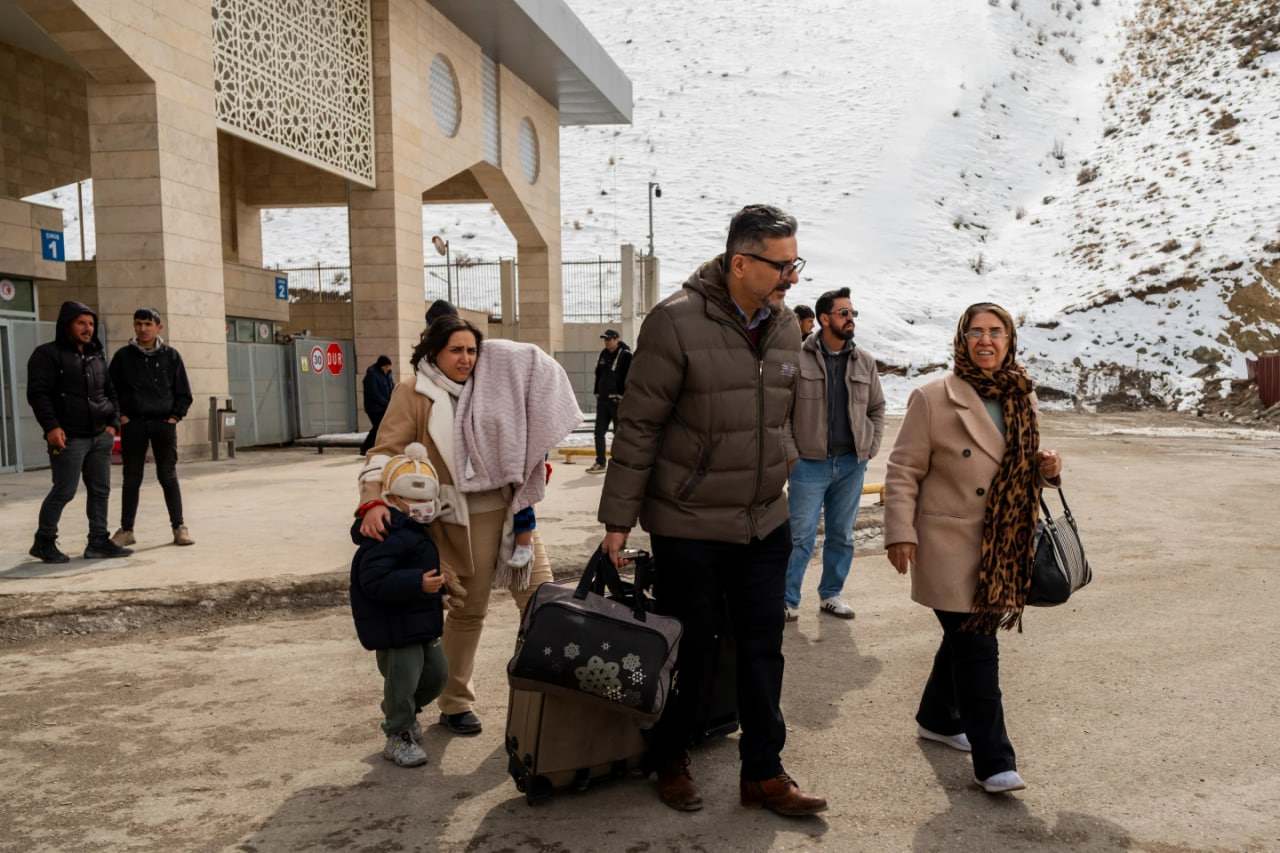
After bombs exploded near her home in the eastern Iranian city of Golestan, 32-year-old hairdresser Merve Pourkaz decided she had no choice but to leave. She traveled nearly 1,500 kilometers to a mountainous border crossing, hoping to reach safety in the Turkish city of Van.
“If they let me, I will stay in Van until the war ends,” Pourkaz told The Associated Press while waiting at the border crossing. “If the war doesn’t end, maybe I’ll go back and die.”
Pourkaz is among the estimated 3.2 million people displaced within Iran since the outbreak of the U.S.-Israel war with Iran, according to the U.N. refugee agency. While some Iranians are seeking shelter in safer areas inside the country or crossing into neighboring states, others are returning from abroad to protect their families and homes.
So far, relatively few people have chosen to leave the country entirely. The United Nations estimates that about 1,300 Iranians have crossed into Turkiye each day since the conflict began. On some days, the number of people returning to Iran even exceeds those leaving. Still, neighboring countries and European governments are increasingly concerned that the conflict could trigger a larger migration crisis if the fighting continues.
At the same time Pourkaz was entering Turkiye, Leila Rabetnezhadfard was traveling in the opposite direction, AP says.
Rabetnezhadfard, 45, had been in Istanbul preparing to marry a German university professor when the fighting broke out. She postponed the wedding and returned to her home city of Shiraz in southern Iran.
“How can I feel safe in Istanbul when my family is living in Iran during the war?” she said. Rabetnezhadfard explained that bringing her family to Turkiye was not feasible because her apartment is small, her brother requires medical care, and living costs in Istanbul are high.
“I will not leave Iran until the war ends,” she said.
Fleeing the fighting
The United Nations has reportedly warned that continued hostilities could force far more Iranians to abandon their homes.
As during last year’s 12-day conflict, many people are choosing to shelter in place. Some lack the financial resources to flee, while others have been influenced by warnings such as the one issued by U.S. President Donald Trump on February 28.
“Stay sheltered. Don’t leave your home. It’s very dangerous outside. Bombs will be dropping everywhere,” Trump said at the time, according to AP.
Despite fears of escalation, large numbers of Iranians have not yet left the country. Instead, many residents of major cities have moved temporarily to rural areas along the Caspian Sea north of the capital, Tehran, according to the International Organization for Migration (IOM).
“Movement out of Iran appears limited mainly because people are prioritizing staying with their families, as well as the safety of their families and property, and due to security conditions and logistical constraints,” said Salvador Gutierrez, head of the IOM mission in Iran.
However, analysts warn that the situation could change rapidly if critical infrastructure is damaged, AP reports, noting that scenario could push large numbers of people toward Iran’s borders with Pakistan, Afghanistan, Turkmenistan, Azerbaijan, Armenia, Turkiye, and Iraq.
“If Tehran, a city of 10 million people, doesn’t have water, they’re going to go somewhere,” said Alex Vatanka, a fellow at the Middle East Institute in Washington.
Iran is already coping with one of the world’s largest refugee populations — about 2.5 million forcibly displaced people, mostly from Afghanistan and Iraq.
Neighbors brace for possible influx
Aid organizations say that if the crisis deepens, the most likely escape routes for refugees will be toward Iran’s borders with Iraq and Turkiye. These borders stretch roughly 2,200 kilometers (1,367 miles) across mountainous terrain inhabited by many Kurdish communities and are difficult to control.
During Syria’s prolonged civil war, Turkiye maintained an “open-door” policy that allowed millions of Syrian refugees to enter the country. However, Ankara has since abandoned that approach for several reasons.
Instead, Turkish authorities are preparing contingency plans to house potential Iranian refugees in “buffer zones” along the border, or in tent cities and temporary housing inside Turkey, according to reports by the Turkish newspaper Hurriyet, citing Interior Minister Mustafa Ciftci.
Many Iranians fleeing the war are unlikely to seek formal refugee status in Turkiye because the asylum process can take years, said Sara Karakoyun, an aid worker with the Human Resource Development Foundation near the border.
“They don’t want to wait in limbo for years for a refugee status they might not get,” she said.
Turkiye has also reinforced its border with Iran. The Turkish Defense Ministry said in January that authorities had built 380 kilometers of concrete walls, installed 203 optical surveillance towers, and established 43 observation posts.
According to Riccardo Gasco, an analyst at the IstanPol Institute, Turkiye may deploy additional troops to secure the border and strictly control the flow of migrants while seeking financial support from the European Union to manage the situation.
Europe prepares for a potential crisis
Europe is also watching the situation closely. The relationship between the European Union and Turkiye was significantly reshaped during the Syrian refugee crisis a decade ago, when nearly two-thirds of the 4.5 million Syrians fleeing the war sought refuge in Turkey. Many later traveled onward to Europe by sea.
In 2016, the EU and Turkiye reached a migration agreement in which Brussels offered Ankara incentives and up to €6 billion ($7.1 billion) to support Syrian refugees in Turkey in exchange for preventing large numbers of migrants from crossing into Greece.
Humanitarian organizations criticized the arrangement, arguing it created overcrowded camps with poor living conditions. However, EU leaders have said the deal helped save lives, reduced irregular migration, and improved conditions for refugees in Turkiye.
The agreement is due for renewal this year, but public sentiment in Turkiye has increasingly turned against Syrian refugees, while anti-immigration political parties have gained momentum in several European countries.
Meanwhile, another humanitarian crisis is unfolding even closer to Europe. Fighting in Lebanon between Israel and Hezbollah has already displaced more than 800,000 people.
“We’ve got a situation in the Middle East that could have grave humanitarian consequences at a time when humanitarian funding has been drastically reduced,” said Ninette Kelley, chair of the World Refugee & Migration Council, referring to cuts to U.S. foreign aid under the Trump administration.
“Is the world ready for another humanitarian disaster?” she asked.