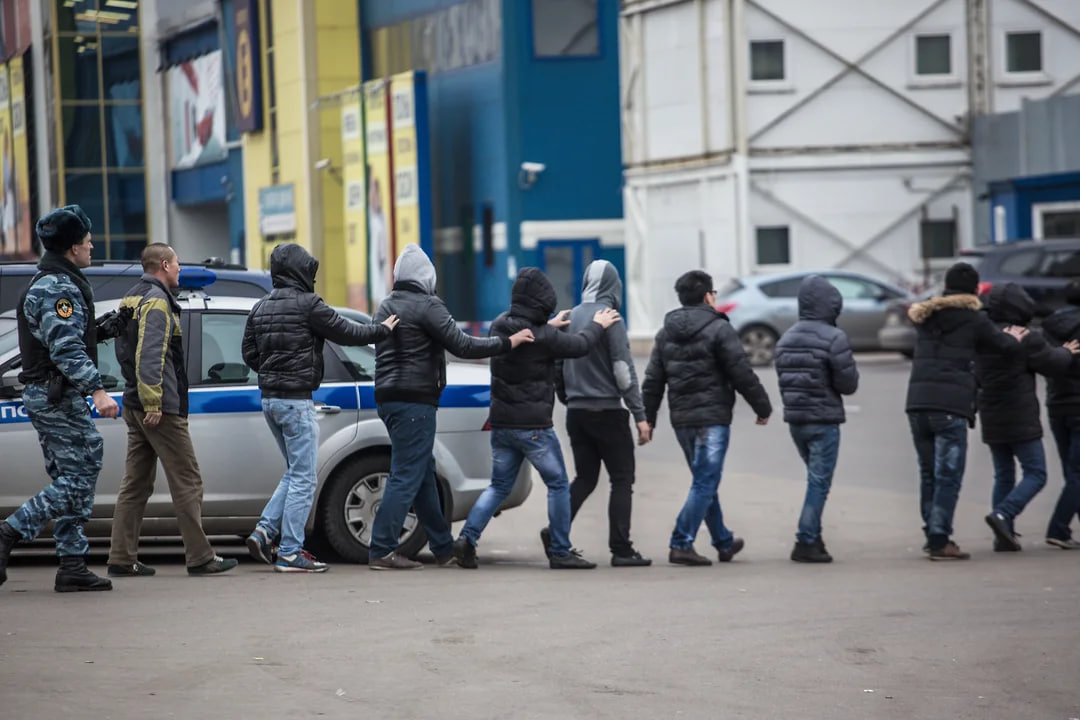
The Russian government has drafted a bill aimed at tightening migration policy and amending the Code of Administrative Offenses (CoAO). The document, developed by the Interior Ministry, was reviewed at a meeting of the government commission on legislative activity, Kommersant reports.
According to the initiative, mandatory deportation of foreign citizens is proposed for 20 types of administrative offenses. These include participation in unauthorized protests, involvement in strikes, activities of undesirable organizations, and violations of a state of emergency regime.
In addition, the CoAO is expected to be supplemented with specific offenses предусматривающие deportation exclusively for foreign nationals — in particular, for minor hooliganism involving disobedience to police officers, as well as for abuse of media freedom, including the dissemination of dangerous content.
Currently, deportation under a number of such articles is applied at the court’s discretion; however, the Interior Ministry proposes making it a mandatory form of punishment.
As explained by Vladimir Gruzdev, Chairman of the Board of the Russian Lawyers Association, in certain cases deportation will be imposed as a mandatory additional penalty alongside a fine. At the same time, the bill provides for a ban on imposing multiple additional sanctions for a single offense. It also proposes increasing fines under 14 articles of the CoAO, including for violations of entry rules and illegal employment, to 4,000–7,000 rubles from the current 2,000–5,000 rubles.
The Interior Ministry says the changes are necessary due to a rise in unlawful activities among foreign nationals. The agency notes an increase in conflict situations, including mass brawls. According to the ministry, around 100 such incidents were monitored in 2023–2024, with approximately 1,500 individuals held accountable.
The ministry also emphasizes that migration flows may contribute to growing social tensions and can be exploited by extremist groups for propaganda purposes.
According to the Federal Security Service (FSB), foreign citizens made 15.6 million trips to Russia in 2025, compared to 16.7 million a year earlier. The number of foreigners in the country fell to 5.7 million by the beginning of 2026, down 10% year-on-year.
The tightening of migration legislation in Russia has been ongoing for the second year. In particular, a registry of controlled persons has been introduced for violators, предусматривающий account freezes and possible deportation, and in some regions — mandatory geolocation sharing via mobile applications. In February 2026, the State Duma also passed in the first reading bills requiring mandatory HIV and drug testing for foreign nationals.
Experts note that the Interior Ministry’s initiative aligns with the broader policy of strengthening control in the migration sphere. At the same time, according to Vadim Kozhenov, head of the Migrant Assistance Center, labor migrants are not generally prone to committing such offenses en masse, and those involved in fights are already deported for long periods. In his view, the new measures are more likely to simplify law enforcement work than significantly change existing practices.