
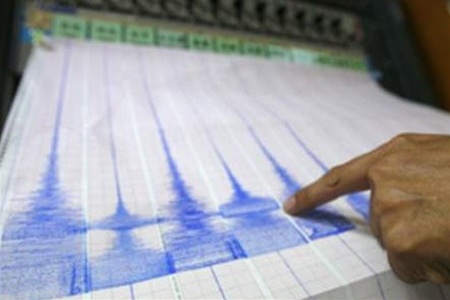
DUSHANBE, November 11, Asia-Plus – A tremor measuring 4.0 points on the MSK-64 scale jolted Dushanbe Sunday morning at 10:15 am, according to the Dushanbe seismic.
The epicenter of the earthquake was reportedly registered 21 kilometers to the southwest of Dushanbe and 11 kilometers to the northwest of the Yovon Township in Khatlon province. The intensity of the quake in the epicenter was evaluated at 5.0 on the MSK-64 scale. No damage has been reported so far.
Meanwhile, The Voice of Russia cited the U.S. Geological Survey as reporting that the earthquake measuring 5.2 points on the Richter scale was registered in the center of Tajikistan Sunday morning. The epicenter of the earthquake was registered 21 kilometers to the southwest of the Tajik capital and 11 kilometers northwest of Yovon at a depth of 17.8 kilometers.
A moderate earthquake of 3.0 magnitude on the MSK-64 scale reportedly could be felt in Dushanbe today morning at 7:03 am.
The Dushanbe seismic station evaluated the intensity of the quake in the epicenter, near the village of Andigan in the Vahdat district, at 4.0 on the MSK-64 scale. No damage has been reported.
The Medvedev–Sponheuer–Karnik scale, also known as the MSK or MSK-64, is a macroseismic intensity scale used to evaluate the severity of ground shaking on the basis of observed effects in an area of the earthquake occurrence. The scale was first proposed by Sergei Medvedev (USSR), Wilhelm Sponheuer (East Germany), and Vit Karnik (Czechoslovakia) in 1964. It was based on the experiences being available in the early 1960s from the application of the Modified Mercalli scale and the 1953 version of the Medvedev scale, known also as the GEOFIAN scale.
With minor modifications in the mid-1970s and early 1980s, the MSK scale became widely used in Europe and the USSR. In early 1990s, the European Seismological Commission (ESC) used many of the principles formulated in the MSK in the development of the European Macroseismic Scale, which is now a de facto standard for evaluation of seismic intensity in European countries. MSK-64 is still being used in India, Israel, Russia, and throughout the Commonwealth of Independent States (CIS).
The MSK scale is somewhat similar to the Modified Mercalli (MM) scale used in the United States. The MSK scale has 12 intensity degrees.
The Richter magnitude scale (often shortened to Richter scale) was developed to assign a single number to quantify the energy released during an earthquake.
The scale is a base-10 logarithmic scale. The magnitude is defined as the logarithm of the ratio of the amplitude of waves measured by a seismograph to an arbitrary small amplitude. An earthquake that measures 5.0 on the Richter scale has a shaking amplitude 10 times larger than one that measures 4.0, and corresponds to a 31.6 times larger release of energy.