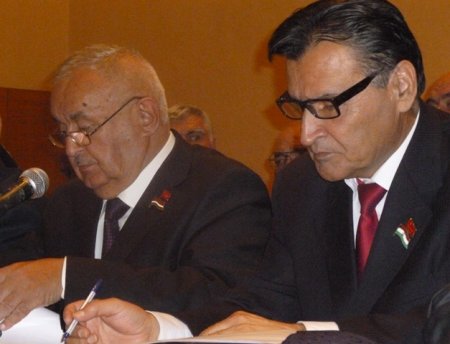
DUSHANBE, March 17, 2014, Asia-Plus — Shodi Shabdolov and Ismoil Talbakov, who represent the Communist Party of Tajikistan (CPT) in Tajikistan’s lower chamber (Majlisi Namoyandagon) of parliament, have prepared amendments to the country’s Constitutional Law “On Elections to the Majlisi Oli (Parliament) of the Republic of Tajikistan.”
“We, in particular, offer to abolish an electoral deposit required from each candidate for the Majlisi Namoyandagon,” Ismoil Talbakov told Asia-Plus in an interview Monday afternoon.
Representatives of political parties and local experts have repeatedly noted that a sizeable electoral deposit prevents many prospective candidates from running.
“Abolition of the electoral deposit will give representatives of science and creative professions to run in parliamentary elections,” PM Talbakov noted.
Besides, deputies representing the CPT in the Majlisi Namoyandagon suggest that 49 percent of deputies of the Majlisi Namoyandagon should be elected from party lists and 51 percent of deputies of the Majlisi Namoyandagon should be elected in single-mandate constituencies.
“But our main proposal is that all political parties officially functioning in the country should be represented in precinct election commissions (PECs) because the fate of election is decided in these commissions,” Talbakov stressed.
According to him, amendments proposed by them to the country’s election legislation were considered at a meeting of the board (Shuro) of the Majlisi Namoyandagon that took place on March 17.
We will recall that the Majlisi Namoyandagon endorsed the bill proving for amendments to the country’s law “On Elections to the Majlisi Oli of Tajikistan” on February 25, 2014.
Authored by Mahmadali Vatanov, the head of the Majlisi Namoyandagon Committee on Legislation and Human Rights, the law, in particular, provides for regulation of the process of voting for Tajik citizens residing abroad. Polling stations established abroad will be headed by heads of Tajikistan’s representative offices in those countries. Besides, under the current election legislation, only 30 to 3,000 people can vote at a polling station. The amendments provide for cancelling this requirement for polling stations set up for Tajik citizens residing abroad. More people can vote at those polling stations.
The law also provides for reducing the electoral deposit required from each candidate from 8,000 somoni to 4,000 somoni and increasing air time for candidates.
The Majlisi Namoyandagon consists of 63 deputies, and currently, 22 of them are elected proportionally from political party lists in a single nationwide constituency with a 5 percent threshold for seat allocation and forty-one deputies are elected in single-mandate constituencies under a two-round majoritarian system.