
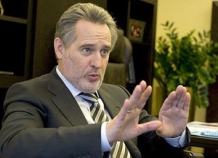
DUSHANBE, April 28, 2014, Asia-Plus — Group DF, which is owned by Ukrainian businessman Dmitry Firtash, has denied claims of Tajikistan’s Agency for State Financial Control and Combating Corruption as absolutely baseless and noted that “it will protect and assert its rights in all courts, including the international ones.”
In a statement released on April 28, Group DF notes that it has completely fulfilled its financial obligations and invested more than 17 million U.S. dollars in Closed Joint-Stock Company (CJSC) TojikAzot.
According to the statement, 45,610,642.72 somoni have been transferred to Tajikistan’s national budget since 2002, when the joint venture was established.
“We consider that claims of Agency for State Financial Control and Combating Corruption of Tajikistan are unfounded and we will protect and assert its rights in all courts, including the international ones,” the statement says.
We will recall that hearing over the case of TojikAzot (the fertilizer factory, which is located in the Tajik southern province of Khatlon) was supposed to start on April 28 but it was adjourned today until June 23.
TojikAzot is partly state owned; one fourth of this joint venture belongs to Tajikistan while Ostark Ventures Limited (Dmitry Firtash is beneficial owner of Ostark Ventures Limited) owns the rest.
The fertilizer plant has not been in operation since 2008 due to lack of natural gas supplies.
Until 2008, when neighboring Uzbekistan upped the price of natural gas, a key input for the factory, TojikAzot served as a foreign investment-success story for Tajikistan’s economy.
Tajikistan’s Agency for State Financial Control and Combating Corruption last month announced an investigation into a 2002 deal between Dmitry Firtash and the Tajik government to create TojikAzot, a plant specializing in the production of carbamide, an organic compound used in fertilizer. The anticorruption agency accuses Firtash of illegal privatization of the company in 2002 and misappropriation of funds.
Firtash was arrested in Vienna on March 12, 2014, and released on a 125 million Euro bail two days later.
Following Firtash’s arrest, Tajikistan’s anticorruption agency charged him on March 15 with the illegal privatization of the clothing factory Guliston in 2002.
Firtash owned 95 percent of the stock, while controversial Tajik tycoon and former minister of industry Zayd Saidov owned the remaining 5 percent. In a ruling handed down on April 2, the Economic Court of Dushanbe granted the claim and transferred the factory ownership to the Tajik Ministry of Industry and Innovations.
The anticorruption agency has argued that Zayd Saidov was involved in the fraudulent privatization of Guliston and TojikAzot.
