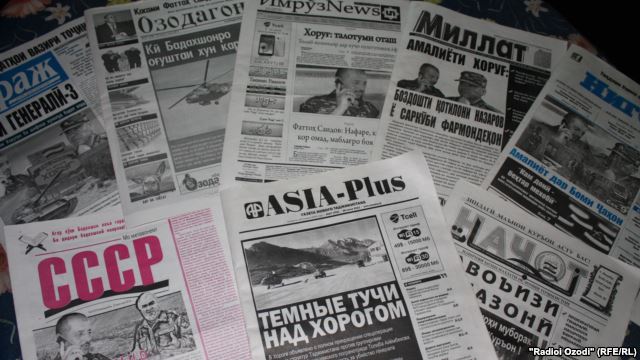
DUSHANBE, April 29, 2015, Asia-Plus — Freedom of the Press 215, released by Freedom House on April 28, ranks Tajikistan 179th among 199 countries and territories in terms of freedom of the press.
Kyrgyzstan is ranked 149th, Russia is ranked 181st and Kazakhstan is ranked 185th.
The report notes that conditions for the media deteriorated sharply in 2014 to reach their lowest point in more than 10 years, as journalists around the world encountered more restrictions from governments, militants, criminals, and media owners.
The report found that the main factors driving the decline were the passage and use of restrictive laws against the media—often on national security grounds—and limits on the ability of local and foreign journalists to report freely within a given country, or even to reach it. In a time of seemingly unlimited access to information and new methods of content delivery, more and more areas of the world are becoming virtually inaccessible to journalists.
While some parts of the world are rendered inaccessible mostly by chaotic violence, others are deliberately barred to most reporters by repressive governments, the report says. Prime examples include China’s Tibet and Xinjiang regions, Tajikistan’s Gorno-Badakhshan Autonomous Region, Russian-occupied Crimea, and certain ethnic minority areas in Myanmar. Citizen journalists, activists, and ordinary residents have managed to disseminate some information about conditions in these regions, but it is no substitute for unfettered reporting by professionals, and it is often easier to send news to the outside world than to reach audiences within the affected area.
Of the 199 countries and territories assessed during 2014, a total of 63 (32 percent) were rated Free, 71 (36 percent) Partly Free, and 65 (32 percent) Not Free.
Only one in seven — about 14 percent — of the world’s inhabitants live in countries with a Free press.
The world’s 10 worst-rated countries and territories were Belarus, Crimea, Cuba, Equatorial Guinea, Eritrea, Iran, North Korea, Syria, Turkmenistan, and Uzbekistan. The Russian-occupied territory of Crimea was assessed separately for the first time in this edition.
In Eurasia, the overwhelming majority of people (82 percent) lived in Not Free media environments.
The Freedom of the Press index is an annual survey of media independence that assesses the degree of print, broadcast, and internet freedom throughout the world. It provides numerical rankings and rates each country”s media as “Free,” “Partly Free,” or “Not Free.” Individual country narratives examine the legal environment for the media, political pressures that influence reporting, and economic factors that affect access to information.
Each country and territory receives a numerical score from 0 (the most free) to 100 (the least free), which serves as the basis for a status designation of Free, Partly Free, or Not Free.