

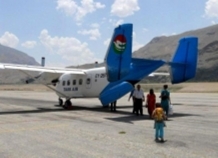
DUSHANBE, July 24, 2015, Asia-Plus — Tajik national air carrier, Tajik Air, has reportedly increased the number of flights from Dushanbe to Khorog, the capital of the Gorno Badakhshan Autonomous Region (GBAO).
Munavvar Murcahyev, an acting spokesman for Tajik Air, says they will operate three flights to Khorog per day.
According to him, the number of flights to Khorog has been increased on the instructions of President Emomali Rahmon for mitigation of effects of natural disasters that hit the Shugnan and Vanj districts as well as in order to improve air services and passenger satisfaction.
Meanwhile, Fayzullo Sattorov, the deputy director general of Tajik Air, says they can use only two AN-28s to operate flights to Khorog.
We will recall that residents of Tajikistan released an open letter to President Emomali Rahmon in early July, asking for support for regulation of the flight Dushanbe-Khorog.
They, in particular, ask the president to help provide regularity of the flights, raise quality and safety of the flights, as well as provide affordability of ticket prices.
The letter notes that Tajik Air uses AN-28 to operate flights from Dushanbe to Khorog. “The civil aviation authorities say the plane meets all requirements of the International Civil Aviation Organization (ICAO) and the International Air Transport Aviation (IATA). But actually, flights on this plane are becoming more and more dangerous,” the letter says.
The letter stresses that no one plane has been purchased over the last twenty years for operating flights to the Gorno Badakhshan Autonomous Region (GBAO). The planes that are used to operate the Dushanbe-Khorog flight have outlived their services life.
“We all remember an air crash that took place at the Khorog airport in 1993 killing dozens of people. In this connection, we ask You, Mr. President, and the Minister of Transport to pay attention to work of the air company operating flights to Gorno Badakhshan and demand that they fulfill their duties properly. This will undoubtedly help avoid new anthropogenic disasters in the future.”
“If local air companies are not able to cope with these tasks, domestic civil aviation market must be open for foreign air companies that could offer better services and competitive tariffs,” said the letter, signed by 140 people.