
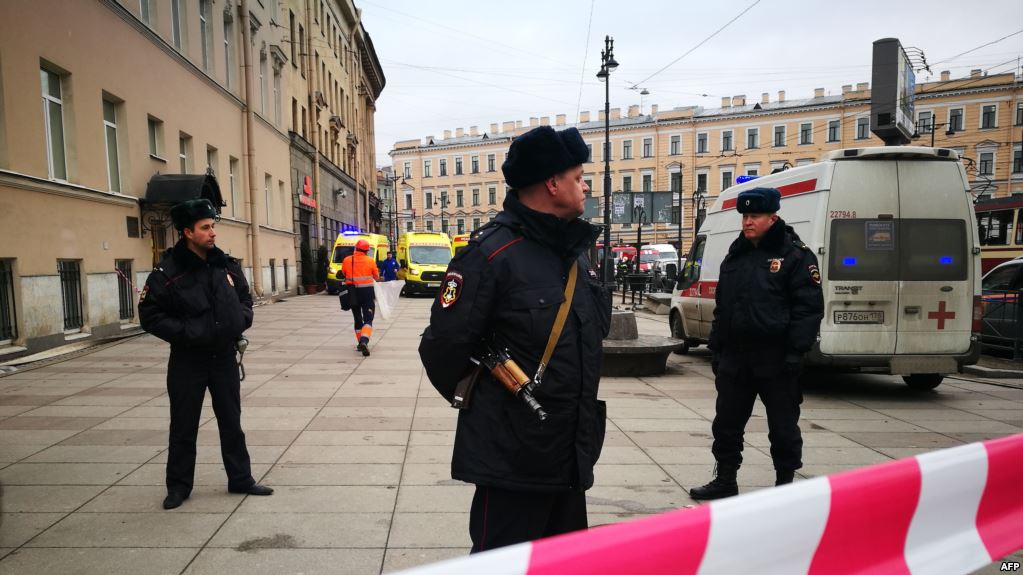
Radio Liberty reports that migrant advocates are warning foreign workers in St. Petersburg to lay low as increased police document checks stoke fears of a wider crackdown on Central Asian and Caucasus migrants following the identification of a Kyrgyz-born Uzbek man as the chief suspect in this week's subway attack.
The Russian Investigative Committee on April 4 identified Akbarjon Jalilov, 22, as the leading suspect in the April 3 bombing that killed 14 people and injured 50.
Some rights activists in Moscow have predicted a clampdown targeting migrant workers, particularly those from Central Asia. They point to what they say was negative stereotyping when Russian media twice published photographs wrongly identifying men from Muslim former Soviet regions as being the organizers of the attack.
REN-TV first published a picture and then video of a bearded man in dark Islamic garb near the site of the explosion widely circulated online. After learning of the accusations from the media, the man later turned himself in to a police station to clear his name and was released after being questioned.
He was identified as Andrei Nikitin, a trucker from the central region of Bashkortostan and a retired paratrooper of the Russian armed forces.
The St. Petersburg news site Fontanka.ru on April 3 strongly suggested in a report that 22-year-old Maksim Aryshev, a citizen of Kazakhstan, was the chief suspect, but the Kazakh Foreign Ministry later denied this, instead saying he was a victim.
On April 3, one Twitter user posted an image, alleging that riot-police officers had entered a movie theater in St. Petersburg and were leading non-Slavic looking people out. That report could not be confirmed, according to Radio Liberty.
Millions of migrants from the former Soviet regions of Central Asia and the North and South Caucasus — where jobs are often scarce — work in Russia, often in low-paying jobs and often without authorization.
In the past, Russian authorities have carried out targeted crackdowns in what analysts have seen as an effort to respond to rising nationalist, xenophobic sentiments in the country.