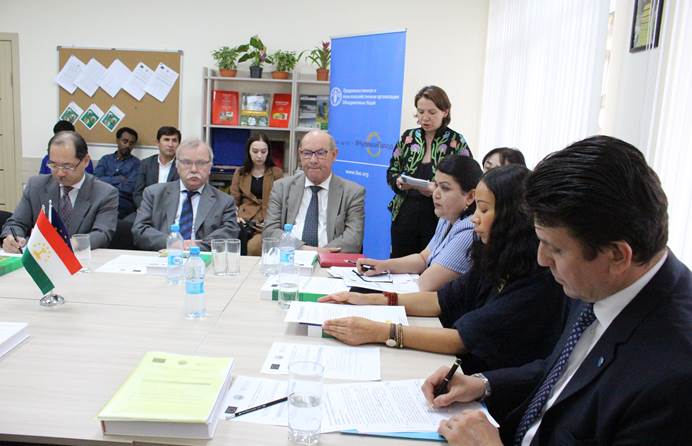
The official opening ceremony of the Agrarian Reform Secretariat (ARS) at the Ministry of Agriculture was held on May 23 with presence of the representatives of the Ministry of Agriculture, the European Union Delegation (EU), the Food and Agriculture Organization of the United Nations (FAO), international organizations, donors’ committees and other relevant agencies and departments.
The Agrarian Reform Secretariat in collaboration with the line ministries, which are engaged in supporting agrarian sector reform, reportedly intends to facilitate the Agricultural Reform Program 2012-2020, ensuring proper implementation.
According to FAO Country Office in Tajikistan, the ARS will coordinate all donor committee activities on agriculture and land, and will become a coordination mechanism between Donors and the Ministry of Agriculture. Simultaneously it will be responsible for monitoring the progress of the implementation of agrarian reform.
The ARS is launched within the framework of a European Union (EU) funded project, which is implemented by the Food and Agriculture Organization of the United Nations (FAO).
“Agriculture is the most important activity and source of livelihood for people in Tajikistan. Therefore, it is vital to pay special attention to agricultural capacity development and focus on institutional strengthening,” emphasized Izatullo Sattori, Minister of Agriculture of Tajikistan.
The secretariat has conducted a series of training sessions dedicated to capacity building of a technical working group of the Ministry of Agriculture for investment project preparation. The courses were designed to create the competencies necessary to attract and retain investment in agriculture. Such activities will be implemented throughout the entire cycle of the project to develop the capacity of national staff and to ensure knowledge and information sharing, as well as cohesion in overall implementation.
“Jointly with European Union, we support the institutional reform process, and the opening of ARS is the important step to advance the reforms. The ARS is aimed to provide technical support in managing the reform process, as well as coordinate the reforms among different partners and stakeholders.” said Oleg Guchgeldiyev, FAO Representative in Tajikistan. “Our goal is to build the capacity of the Ministry staff by growing their technical knowledge, with a focus on the planning, monitoring, evaluation and impact assessment of capacity strengthening initiatives. High-quality technical support contributes to increasing the capacity of the ministry’s staff, speeding up the development and adoption of management decisions aimed at reforming the sector.”
The strengthening of technical capacities between the Agrarian Reform Secretariat and the Ministry of Agriculture will provide a sound basis for improved implementation and monitoring of the Agrarian Reform Program 2012-2020.