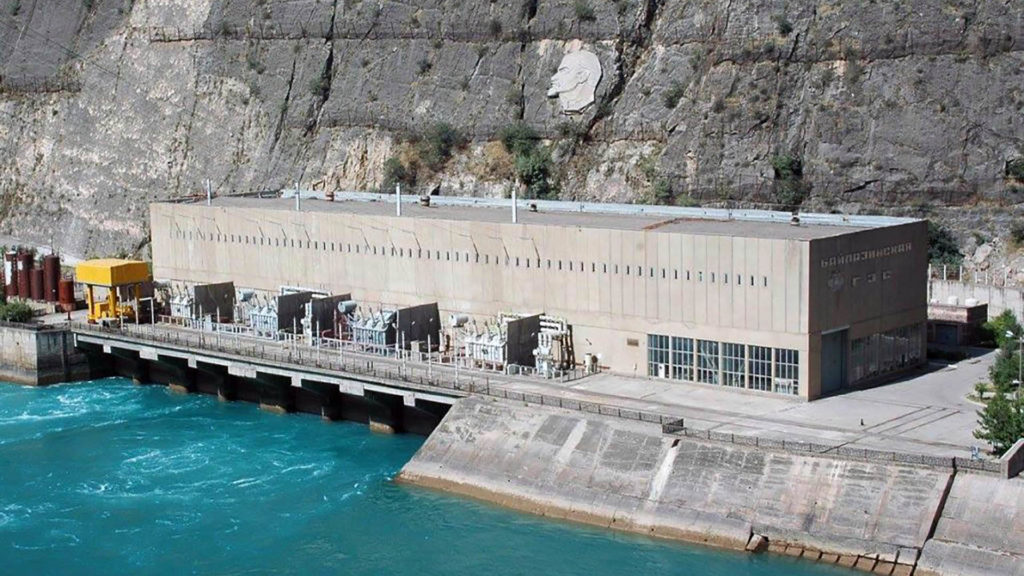
The Eurasian Fund for Stabilization and Development (EFSD) is exploring the issue of participation in financing rehabilitation of the Baipaza hydroelectric power plant (HPP) in Tajikistan.
According to the Eurasian Development Bank, the issues related to the necessity and prospects of rehabilitation of the Baipaza hydropower plant were discussed in Dushanbe with top managers of the Ministry of Energy and Water Resources of Tajikistan and Barqi Tojik (Tajikistan’s national integrated power company) during a visit of a joint mission of the EFSD and the World Bank to Tajikistan (September 16-20).
The mission members reportedly visited the Baipaza hydropower plant that had been introduced into operation more than thirty years ago.
The mission members also visited the Nurek hydropower plant to discuss the plan of rehabilitation of it.
The Baipaza Dam is a concrete face rock-fill dam on the Vakhsh River about 9 kilometers southeast of Yovon in Khatlon province. A purpose of the dam is hydroelectric power generation and it supports a 600 MW power station. The first three 150 MW Francis turbine-generators were commissioned in 1985, the fourth in 1986. Its reservoir also holds water for the irrigation of some 40,000 ha in Yovon and Obikiik districts. This is accomplished by a 7.3-kilometer long tunnel which runs from the right back of the reservoir and through a mountain to the valley.
The Eurasian Fund for Stabilization and Development (the former EURASEC Anti-crisis Fund) is an international financial institution established by Armenia, Belarus, Kazakhstan, Kyrgyz Republic, Russia and Tajikistan with the goals to assist its member states in overcoming the consequences of global financial crisis, to ensure their long-run economic stability and to foster economic integration of EFSD member-countries. The Fund assists member states with the following instruments: financial credits, available to governments only; investment loans, provided either to EFSD member states or to companies implementing interstate and national investment projects; grants to finance government programs in social sector.
EFSD credits and loans are repayable, have finite maturity, carry interest and are extended in US Dollars or Euros. While lending to low income countries, EFSD is guided by International Monetary Fund (IMF) recommendations on loan concessionality. The prospective borrower should have no debt arrears to the Fund itself, to any of its member countries, or to other international financial institutions.