In 2018, the United States Agency for International Development (USAID) and the Aga Khan Foundation (AKF) launched Thrive Tajikistan, a five-year program to improve the quality of life for people living along the Tajik-Afghan border, according to the Aga Khan Development Network (AKDN).
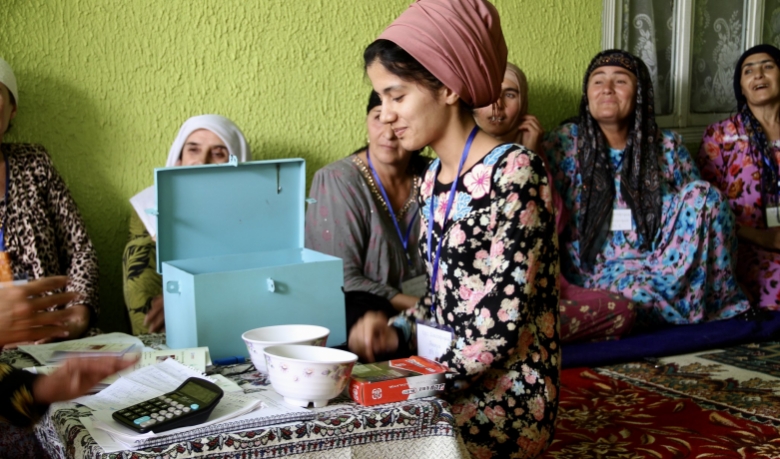
One of the program’s components establishes community-based savings group (CBSGs) that train women and men on basic financial literacy and cash management skills. CBSGs also provide an important social platform for discussing local issues.
Across Tajikistan, AKF has reportedly helped to start 2,600 CBSGs over the past two decades, greatly improving young people’s ability to start their own enterprises. In Khatlon province alone, AKF has helped communities create CBSGs that serve over 3,000 members, 80% of whom are women.
For CBSGs, AKF’s training provides tools for bookkeeping and financial management best practices, taking out loans, and management of a social fund, a small pool of cash reserved for the village’s poorest families in times of need.
The groups encourage trust amongst members with their built-in accountability mechanism where three members hold separate keys to a cashbox containing the group’s contributions. All three keys are needed to access the pool. The group helps to create a safety net for both its members and the broader community – improving their financial well-being and protecting them and their families from additional economic hardship.
Anora, age 20, lives in a small village in the Khatlon province. In early 2019, she gathered with other participants of the village’s mahalla committee, a form of village-level governance, to establish a community-based savings group.
Like many young women in the Khatlon province, Anora lacks access to savings and credit, leaving her vulnerable to financial shocks like medical emergencies or natural disasters. The savings group addressed this gap by improving Anora’s and other members’ access to locally managed financial services.
In 2019, Anora’s group paid out loans to members totaling US$ 982. This is a powerful resource in a place where only about one in three low-income households has a bank account.
Anora is now studying to teach English and attends school part-time with support from her CBSG. She took out a loan to continue her studies at the University of Bokhtar, with plans to graduate in two years.
The CBSG is helping to make Anora’s dreams for the future real. It also shows other young women that they can take hold of their financial futures and improve their quality of life.