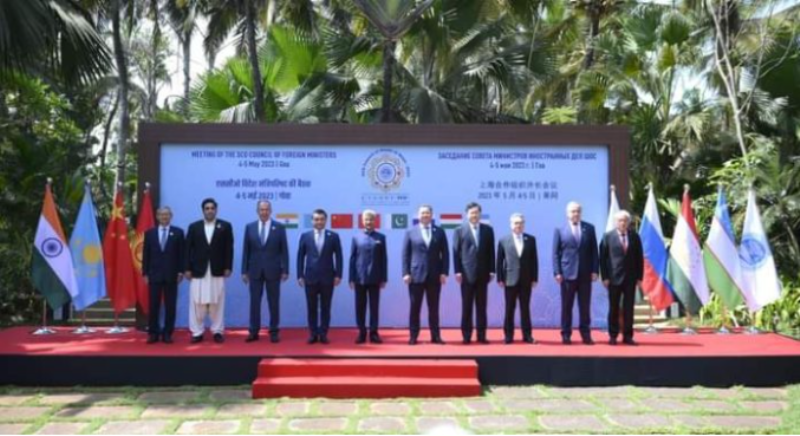
Tajik Foreign Minister Sirojiddin Muhriddin arrived in the Indian city of Goa on Thursday to attend the Shanghai Cooperation Organization (SCO) Council of Foreign Ministers’ meeting,
Indian media reports say that chaired by India’s External Affairs Minister S Jaishankar, a two-day SCO foreign minister’s meeting kicked off at the sea-side Taj Exotica resort in Goa's Benaulim on July 4.
During the meeting, the regional counterparts are reportedly discussing various regional, security, and political issues.
India Today says this crucial meeting will set the stage for the SCO Leaders’ Summit to be held in New Delhi in July.
NDTV reports that foreign ministers of the SCO member nations are finalizing in their deliberations on Friday a set of 15 decisions or proposals for the consideration of the SCO Leaders’ Summit.
The proposals are reportedly aimed at expanding cooperation among the SCO member countries in the areas of trade, technology, commerce, security and socio-cultural ties.
The theme of India’s Chairmanship of SCO in 2023 is ‘SECURE-SCO’. India attaches special importance to SCO in promoting multilateral, political, security, economic and people-to-people interactions in the region.
The Shanghai Cooperation Organization was founded at a Summit in Shanghai in 2001 by the presidents of Russia, China, Kyrgyzstan, Kazakhstan, Tajikistan and Uzbekistan. It was preceded by the Shanghai Five mechanism.
The Shanghai Cooperation Organization currently has eight full members — China, Kyrgyzstan, Pakistan, Russia, Tajikistan, India, Kazakhstan and Uzbekistan.
Iran (September 17, 2021) and Belarus (September 16, 2022) are acceding members.
Besides, Afghanistan, Belarus, Iran and Mongolia are four observer states.
SCO’s dialogue partners include Armenia, Azerbaijan, Cambodia, Egypt, Nepal, Qatar, Saudi Arabia, Sri Lanka and Turkiye.
Bahrain, Kuwait, Maldives, Myanmar and the United Arab Emirates (UAE) are upcoming dialogue partners.
ACEAN, CIS, Turkmenistan and the United Nations are guest attendances.
Initially focused on regional security, including border conflicts, terrorism and militant Islam, its activities have expanded to cover economics and trade, transport and law enforcement. Security and economic cooperation remain priorities. China and Russia are the dominant members. Russia regards Central Asia as its sphere of influence but Chinese economic sway is growing. At an informal level, the SCO is a diplomatic platform that helps address and contain potential friction.