The Spiritual Administration of Muslims of Kyrgyzstan (DUMK) has supported the recently introduced ban on wearing niqabs in public places, calling this item of clothing “alien to society.” Fergana news agency reports that the corresponding statement was published on the religious organization's website.
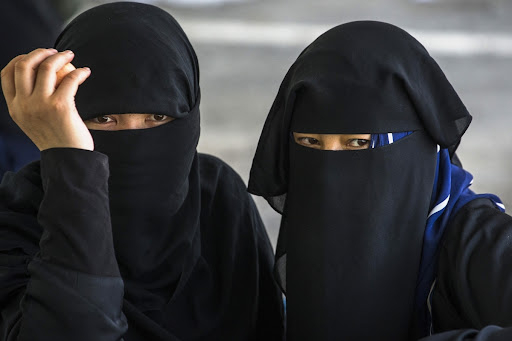
The muftiyat emphasized that there are ongoing discussions regarding the introduced ban, so the organization decided to clarify its position. As noted by DUMK, according to Sharia law, an adult Muslim woman should conceal her body except for her face and hands. Accordingly, the hijab (headscarf) and loose clothing are mandatory for women. The niqab, which completely covers the face and leaves only a slit for the eyes, is not obligatory.
"The niqab is an alien phenomenon to our society. In today's realities, there is a possibility that under the guise of our sisters wearing the niqab, villains dressed in women's clothing could threaten public safety. Therefore, it is important to walk with an open face to be recognizable," the DUMK statement says.
The religious organization also reminded that manipulating religious issues and using them to incite rebellion or other political actions is considered a sin in Islam.
Debates over the niqab began after the police in the Jalal-Abad region started conducting educational work with women appearing on the streets with their faces covered.
Law enforcement officers handed out leaflets to Muslim women about the ban on this type of clothing and warned that repeated violations of the law would result in a fine of 20,000 soms (US$230).
Kyrgyzstan's President Sadyr Japarov also commented on the situation. He explained that the hijab, essentially an ordinary headscarf, is a traditional headwear for mothers, sisters, and grandmothers. Whether to wear it or not is a personal choice for each woman, as is how to wear it, for example, wrapping it around the head or tying it under the chin. The main thing, according to the president, is that the face remains uncovered.
In this regard, the niqab, which only leaves the eyes uncovered, as well as the full-body burqa, are banned by the muftiyat.
"In our traditions, women have never worn the burqa, and it shouldn't be turned into a problem," Japarov concluded.
He added that the ban is not an initiative of the authorities, who do not interfere in religious matters, but rather rules set by the Spiritual Administration of Muslims of the republic, and the state is simply helping to ensure their implementation.
On January 21 of this year, Japarov signed laws related to the religious sphere. In particular, one of the provisions in these documents included a ban on wearing clothing that prevents the identification of a person in public places.