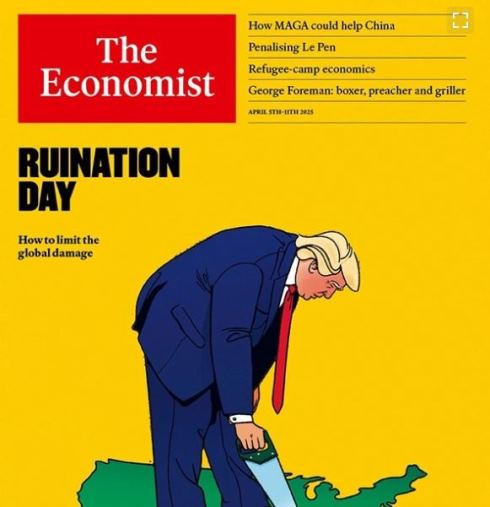
On April 2, U.S. President Donald Trump announced the introduction of large-scale tariffs on imports of goods and products from 185 countries and territories.
Trump explained the new tariff policy as “protecting American industry, reducing the trade deficit, eliminating unfair trade practices, and restoring U.S. economic sovereignty.” He believes that trading partners are taking advantage of the U.S. by selling more to America than they buy from it, and that their tariffs are higher than those of the U.S.
“Today's retaliatory tariffs are intended to level the playing field,” he stated.
The base tariffs of 10% introduced by Trump for about 160 countries and territories, including Tajikistan, came into effect on April 5. For 27 countries, higher tariffs exceeding 20% were set to take effect on April 9.
Countries with higher tariffs include, for instance:
- China – 125% (initially 84%, later 104%)
- EU – 20%
- Japan – 24%
- India – 26%
- Vietnam – 46%
- South Korea – 25%
- Kazakhstan – 27%
However, on April 9, the U.S. raised import tariffs on goods from China from 104% to 125%. As for other countries, a 90-day pause for negotiations has been introduced, during which a 10% tariff will apply to all imports into the U.S.
Not all bad news
Despite the minimum rate (10%) being set, the new U.S. tariff policy does not apply to all goods. There are products for which imports, regardless of the supplier country, will be subject to a zero customs rate.
Such products include crude oil and energy resources. The White House explains this exception due to “the high dependency of global energy markets and the strategic importance of this resource for the U.S.”
Additionally, certain industrial components and dual-use goods, such as microelectronics, are excluded from Trump's tariffs. Key components for U.S. strategic industries include: semiconductors and microchips; lithium and rare earth metals (imported from allied countries); some types of solar panels and electric vehicle batteries, provided they meet the rules of origin.
There could even be exemptions or preferential rates if it is proven that the product is critical to the American economy.
Also exempt from the new tariffs are critical medical goods such as medicines, vaccines, and personal protective equipment.
Moreover, duty-free shipments can continue for countries with various trade agreements with the U.S., including Canada, Mexico, Chile, the Dominican Republic, Costa Rica, El Salvador, Guatemala, Honduras, and Nicaragua.
Interestingly, Russia, Belarus, North Korea, and Cuba were not included in Trump's list, with the White House explaining this by the lack of trade with these countries. However, it is worth noting that Russia did trade with the U.S. in 2024, amounting to US$3.5 billion (0.4% of Russia's total foreign trade turnover in 2024). According to the U.S. Trade Service, Russia exported mineral fertilizers, platinum, turbojet engines and their components, and other goods in small quantities.
Global hysteria
The new U.S. tariff policy has sparked widespread resonance globally, with concerns from many experts about potential significant changes in international trade, slowing economic growth, and rising consumer prices.
US media outlets have dubbed Trump's actions “the start of a tariff war,” which they argue will push the U.S. toward recession and hurt the wallets of ordinary Americans. International experts have raised the risks of a global economic crisis, citing a sharp fall in the dollar, a collapse in stock indices, and a drop in oil prices following Trump's announcement.
Small Raw Material Satellites
Almost all Central Asian countries listed by Trump are among those subject to the minimum tariff (10%). This is due to the small volume of supplies from the region, mainly raw materials.
The only country in the region that faced a higher tariff (though now paused) is Kazakhstan (27%)—it is a relatively large trading partner of the U.S. among the Central Asian nations.
Will the ‘trade war’ affect Tajikistan?
According to the Agency for Statistics under the President of Tajikistan, the bilateral trade between Tajikistan and the United States last year valued at US$147.3 million, which represented 1.6% of the country’s total foreign trade turnover. This consisted of Tajikistan’s exports to the U.S. estimated at only US$15.3 million (0.8% of Tajikistan’s total exports in 2024) and Tajikistan’s imports from the U.S. worth US$132 million.
Tajikistan exports small amounts of natural juices, dried fruits, and some mineral products (raw materials) to the U.S.
Earlier, the American publication Defense News wrote that the U.S. mainly imports antimony from China, in smaller quantities from Russia, “while Tajikistan strengthens its position as the third-largest supplier of antimony globally.”
Tajik experts do not expect any direct impact from Trump's tariffs on Tajikistan, but they do not rule out indirect effects on the economy, both of Tajikistan and the wider region.
Sulaymon Orifov, an expert on economic issues, believes that if the new U.S. foreign trade policy is implemented as Trump presented it, Tajikistan and other Central Asian countries may suffer in the future due to falling raw material prices.
He explained his statement as follows: “Trump's tariffs and possible retaliatory increased rates on the U.S. will disrupt trade chains and reduce global trade. Goods will become more expensive, and there will be fewer buyers. Additional price pressure will ultimately fall on consumers, whose purchasing power will decrease.”
This will lead to a reduction in trade, which in turn will reduce production and employment. The cycle repeats, leading to decreased demand for raw materials, which constitute the bulk of the region's exports.